
Can You Add Charging to Existing Phone Lockers? (The Ultimate Retrofit Guide)
Yes, you can add charging capabilities to existing phone lockers by installing retrofit power kits, individual USB modules, or surface-mounted charging hubs. While most lockers are sold as "passive" storage, high-quality metal and phenolic units are structurally capable of supporting integrated power with the right hardware.
In this guide, you will learn how to:
- Assess if your current lockers are compatible with power upgrades.
- Choose between professional retrofit kits and DIY modules.
- Maintain compliance with UL 962A safety standards.
- Calculate the cost-effectiveness of retrofitting versus buying new.
Is It Possible (and Safe) to Retrofit Lockers?
It is absolutely possible to retrofit existing lockers, provided the unit has sufficient depth and rear access. Most industrial-grade cell phone lockers are constructed from galvanized steel or high-pressure laminate (HPL), both of which can be modified to house wiring.
The primary constraint is physical space. A standard smartphone requires a compartment depth of at least 150mm to 200mm to accommodate both the device and the protrusion of a charging cable and plug. Before starting, verify that your locker bank has a "dead space" or a chase behind the units where power strips or bus-bars can be safely hidden from user tampering.
Common Mistakes to Avoid:
- Assuming all materials are equal: Drilling into phenolic (HPL) lockers requires different bits than steel to prevent cracking.
- Ignoring depth: Forgetting that a plugged-in USB-C cable adds 2-3cm of length to a phone's footprint.
3 Ways to Add Charging to Existing Lockers
Option 1: The Integrated Retrofit Kit (Professional)
This is the cleanest solution for large-scale facilities. A professional kit typically uses a vertical "bus-bar" or power rail that mounts to the back of the locker frame. A small hole is drilled into each compartment, and a proprietary USB charging head is snapped into place.
Option 2: Individual Power Modules (DIY/Mid-Range)
If you have a moderate number of units, you can use flush-mount USB grommets. This involves using a hole saw (typically 50mm) to create a circular cutout in the back or side of the locker. A "pixel" style USB charger is then inserted and tightened with a plastic nut. This is highly effective for different sizes of cell phone lockers where you may only need to power specific compartments.
Option 3: Surface-Mounted Power Strips (Budget)
For a non-permanent solution, industrial-strength adhesive or magnetic USB hubs can be mounted to the interior ceiling of each locker. Cables are then routed through existing ventilation louvers to a central power source at the rear.
The "Heat Problem": Ventilation & Safety Standards
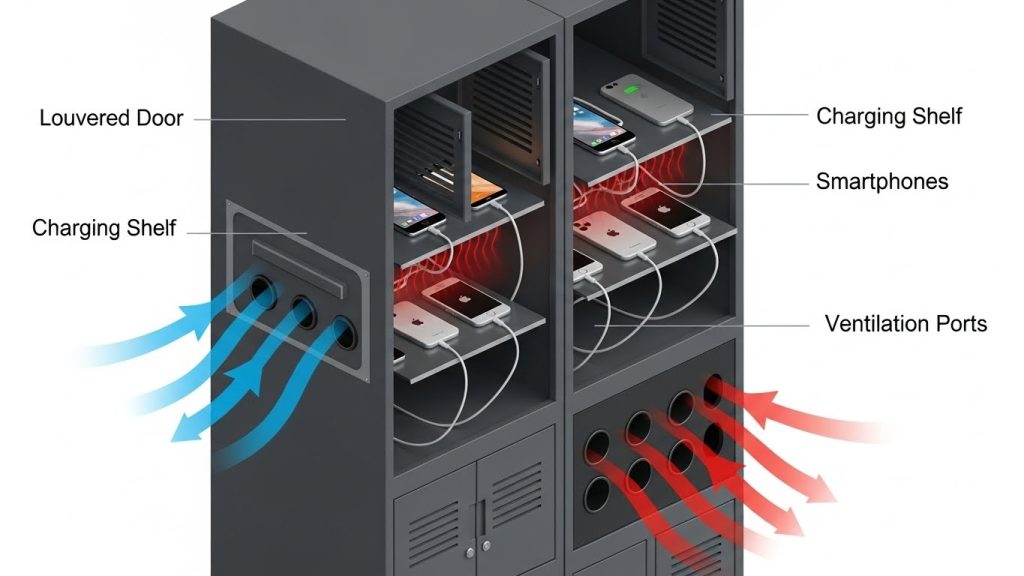
Safety is the biggest concern when adding power to an enclosed space. When 30 to 50 phones are charging simultaneously in a confined bank, they generate significant ambient heat.
To remain compliant with UL 962A (Furniture Power Distribution Units), you must ensure the locker has adequate airflow. If your units are solid-door steel, you may need to perforate the back panels or switch to mesh doors. This is why power and internet requirements for lockers often dictate the physical design of the cabinet itself.
Safety Checklist:
- Circuit Protection: Use a master power strip with a built-in circuit breaker.
- Cable Routing: Ensure no cables are pinched when the locker door is slammed.
- Ventilation: Maintain at least 5% open-air ratio per compartment for heat dissipation.
Cost Analysis: Retrofit vs. Buying New Charging Lockers
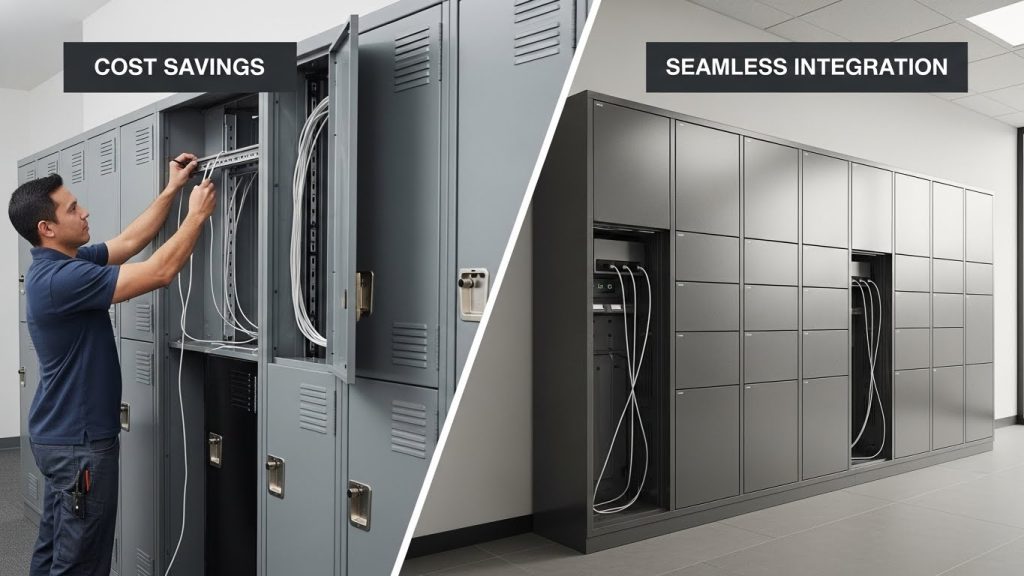
Retrofitting is generally the more sustainable choice for organizations with a limited capital budget.
| Feature | Retrofit Existing Units | Buying New Charging Lockers |
| Hardware Cost | $15–$40 per door | $80–$150 per door |
| Labor | High (Drilling/Wiring) | Low (Placement only) |
| Estimated Savings | 40–60% (needs verification) | 0% |
| Aesthetics | Visible cables/modules | Fully integrated/Hidden |
While retrofitting saves on the cost of the steel itself, the labor cost for a technician to drill 100 lockers can add up. However, for high-end custom units, retrofitting preserves your initial investment.
Maintenance: Managing Cables and Wear-and-Tear
Cables are the first point of failure in any charging system. In a high-traffic environment, users may pull on cables or try to use their own, leading to frayed wires or broken ports.
For 2026 standards, it is recommended to install 3-in-1 braided cables (USB-C, Lightning, and Micro-USB) that are anchored to the locker frame with P-clips. This prevents the cable from being pulled out of the charging module. Additionally, consider where you install your cell phone lockers to ensure the master power plug is accessible for maintenance but hidden from the general public.
Frequently Asked Questions (FAQ)
Is it safe to charge a phone in a metal locker?
Yes, it is safe as long as the electrical components are properly grounded and the locker has sufficient ventilation to prevent heat buildup. Always use UL-listed charging modules.
Do I need an electrician to add charging to my lockers?
You do not usually need an electrician for "plug-and-play" retrofit kits, but a licensed professional should be consulted if you are hardwiring a master power supply into the building’s electrical grid.
Do phone lockers need ventilation for charging?
Yes, charging generates heat, and an airtight metal box can cause batteries to overheat. You should ensure the locker has louvers, mesh panels, or a 10mm gap at the back for airflow.
How much does it cost to add charging to a locker?
Retrofitting costs typically range from $15 to $40 per compartment for hardware, depending on whether you choose standard USB or fast-charging USB-C ports (needs verification).
What is the best "no-drill" charging option?
Surface-mounted USB hubs with industrial-strength 3M adhesive are the best no-drill option, though cables must still be routed through existing holes or louvers.
Can I add wireless charging to existing lockers?
Yes, wireless charging pads can be adhered to the bottom of the locker shelf, though they require the phone to be placed perfectly, which can be difficult in small compartments.
Conclusion
Adding charging to your existing lockers is a viable way to upgrade your facility without the expense of a full replacement. By selecting the right retrofit kit and prioritizing heat management, you can provide a high-value service to your students, employees, or guests.
