
Where Should You Install Cell Phone Lockers for Best Flow?
The best places to install cell phone lockers are high-visibility "transition zones" such as entrance vestibules, main reception areas, and employee breakrooms. Proper placement ensures that security is maintained without creating hallway bottlenecks or disrupting the daily movement of students or staff.
In this guide, you will learn how to:
- Identify high-traffic "hot zones" to avoid congestion.
- Calculate "throughput" for smooth shift changes.
- Ensure full ADA compliance for mounting heights.
- Select the right mounting style for your hallway dimensions.
Understanding "The Flow": Why Placement Trumps Quantity
In facility management, "flow" refers to the frictionless movement of people through a space. When installing cell phone lockers, many organizations make the mistake of focusing on quantity—how many units they can fit—rather than "throughput," or how many people can access their phones per minute.
If you place a large bank of lockers at the end of a narrow, dead-end hallway, you create a "pinch point." Users must fight through oncoming traffic to reach their lockers and then backtrack through the same crowd to exit. This leads to frustration and often results in the lockers being underutilized. For a successful rollout, lockers must be positioned along existing natural pathways.
Common Mistakes to Avoid:
- Dead-end placement: Forcing users to backtrack through a crowd.
- Corner clusters: Installing lockers too close to a 90-degree turn where visibility is low.
- Ignoring the "Stall" Factor: Not accounting for the 10–15 seconds it takes for a user to input a code or use a key.
Top 5 High-Flow Locations for Cell Phone Lockers
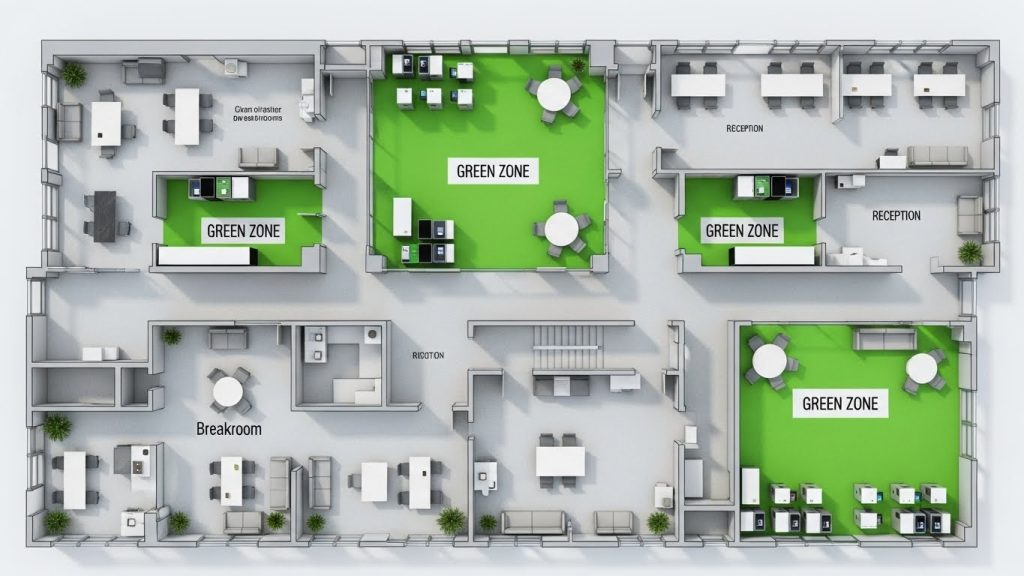
1. The Entrance Vestibule (The "Clean Zone" Approach)
The entrance vestibule is the gold standard for high-security environments like courthouses, correctional facilities, or data centers. By placing lockers here, you establish a "clean zone" where no unauthorized devices pass the secondary security checkpoint. This location is ideal for visitors who are unfamiliar with your facility's layout.
2. Centralized "Hubs" Near Supervision
If theft or vandalism is a concern, centralized hubs near a reception desk or administrative office are best. High-visibility areas naturally deter tampering. When lockers are within the line of sight of staff, users feel more confident leaving expensive devices behind.
3. Transition Zones (Locker Rooms & Breakrooms)
For industrial and manufacturing settings, the best placement is often in the breakroom or near the main employee locker room. Employees are already in a "storage mindset" in these areas. Integrating phone storage here minimizes the time spent transitioning from personal time to the production floor. Before purchasing, it is helpful to understand how many phones a phone locker can hold to ensure the breakroom can handle the entire shift's devices.
4. The "In-Classroom" Cluster (For Education)
In schools, centralized hallway lockers often lead to tardiness. Instead, "mini-clusters" installed directly inside or just outside the classroom door allow teachers to monitor the storage process without students needing to travel across the building between periods.
5. High-Visibility Alcoves
If your hallways are narrow, look for existing architectural alcoves. These "dead spaces" are perfect for surface-mounted units because they keep the lockers out of the main walking path while remaining easily accessible.
Technical Logistics: Mounting & Compliance
ADA Mounting Heights for 2026
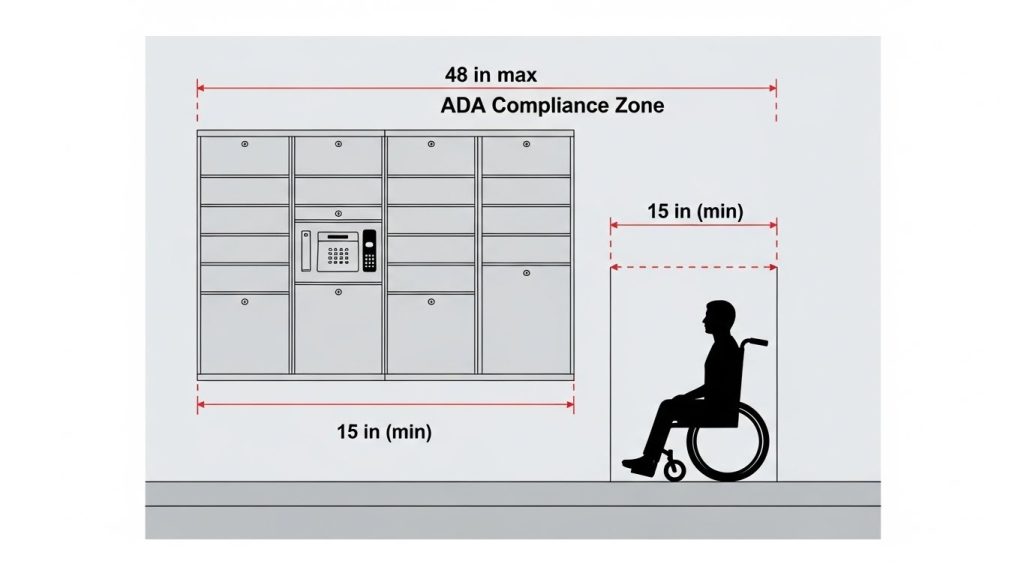
Accessibility is a legal requirement, not an option. According to current ADA standards (needs verification for 2026 updates), at least 5% of your locker compartments must be accessible to users in wheelchairs.
- Max High Reach: 48 inches from the floor.
- Min Low Reach: 15 inches from the floor.
- Pro-Tip: Ensure there is a clear floor space of at least 30" x 48" in front of the ADA-compliant units to allow for a parallel or forward approach by a wheelchair.
Recessed vs. Surface-Mounted Flow
The physical profile of the locker affects the hallway's "effective width."
- Recessed Mounting: The unit is tucked into the wall. This is the best choice for narrow corridors because it leaves the floor space completely clear.
- Surface Mounting: The unit hangs off the wall. This is easier to install but can be a hazard if the unit protrudes more than 4 inches into a walking path (per ADA protruding object rules).
When deciding on a style, consider what sizes cell phone lockers come in to determine how much wall depth or hallway space you will actually lose.
Solving the Congestion Crisis: The "Shift Change" Strategy
In facilities with hundreds of employees, a "shift change" can become a logistical nightmare if all phone lockers are in one spot. To maintain flow, consider "Locker Islands." Instead of one massive wall of 200 lockers, install four separate stations of 50 lockers each, distributed near different department entrances. This spreads the "crowd density" and allows everyone to exit the building faster.
The "Throughput" Checklist:
- Are the lockers placed near a Wi-Fi or cellular "dead zone" to discourage loitering?
- Is there enough light for users to see small keyholes or digital pads quickly?
- Have you accounted for the cost of cell phone lockers when deciding between one large unit versus several distributed smaller units?
Safety & Visibility: The "Security Triangle"
Effective placement relies on the "Security Triangle": Lighting, Surveillance, and Traffic. Lockers should always be installed in well-lit areas. If you are using CCTV, ensure the lockers are placed at an angle where the camera can see the person accessing the locker without their body blocking the view of the compartment door.
Frequently Asked Questions
For general use, the top row is typically at eye level (approx. 60 inches), but for ADA compliance, at least some lockers must be within a 15-inch to 48-inch reach range.
While not strictly required, placing lockers in a supervised area or under 24/7 camera surveillance significantly reduces the risk of theft and vandalism.
Decentralize your lockers by placing smaller units near specific work zones or classrooms rather than one large bank at a single exit point.
Only if they are specifically rated for outdoor use with weatherproofing and rust-resistant coatings; otherwise, they should stay in climate-controlled environments.
You should allow for at least 36 to 48 inches of clearance to allow a person to stand or sit in front of the unit without blocking the entire hallway.
Digital locks are often faster for users as there is no fumbling for keys, but they require more maintenance (battery changes) to keep the flow consistent.
Conclusion
Strategic placement of cell phone lockers is the difference between an organized facility and a daily bottleneck. By prioritizing transition zones, adhering to ADA reach ranges, and distributing units to handle shift-change crowds, you ensure your investment actually gets used.
