
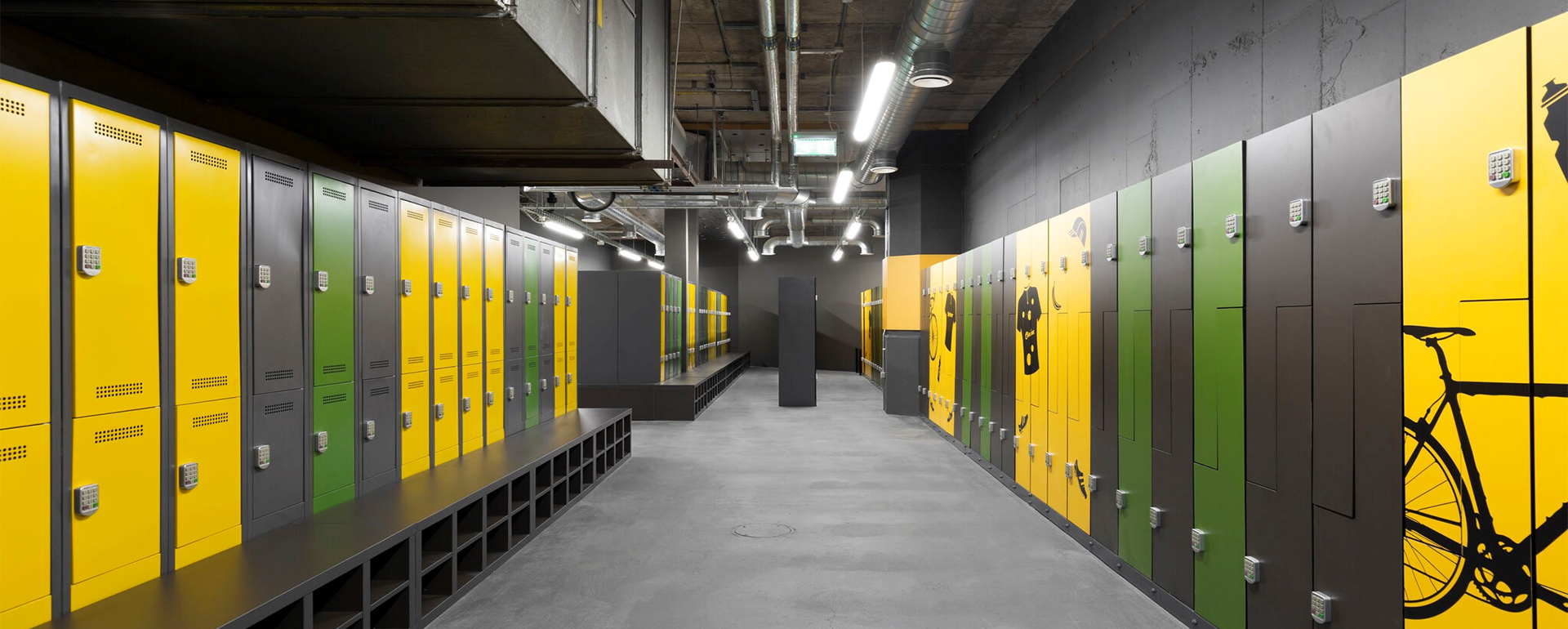
How Many Phones Can a Phone Locker Hold? Capacity Planning Guide
A standard phone locker typically holds between 10 and 60 devices per unit, though high-capacity industrial cabinets can accommodate upwards of 300 slots. To find the right fit, you must calculate your total user headcount and add a 10–15% buffer for guests and larger modern devices.
In this guide, you will learn how to:
- Calculate the exact number of slots required for your specific headcount.
- Determine if your hardware accommodates plus-sized phones and rugged cases.
- Choose between wall-mounted, floor-standing, and modular configurations.
- Plan for future-proof growth in school or corporate environments.
Understanding Standard Phone Locker Capacities
When selecting cell phone lockers, capacity is categorized by the total number of individual locking compartments (slots). Manufacturers generally group these into three tiers based on the intended installation environment:
- Small/Compact Units (8–15 Slots): Best for small meeting rooms, boutique fitness studios, or specialized laboratory entrances. These are almost always wall-mounted to save floor space.
- Medium Units (30–60 Slots): The "standard" for K-12 classrooms and medium-sized office departments. These units balance visibility with storage density.
- High-Capacity Cabinets (100–300+ Slots): Designed for large manufacturing facilities, distribution centers, or government buildings. These are typically heavy-duty floor-standing units or banks of modular lockers bolted together.
Common mistakes to avoid:
- Buying for current headcount only: Always assume your team or class size will grow by at least 10%.
- Ignoring depth: Some "high capacity" lockers achieve a high slot count by making compartments shallow, which may not fit modern, deeper smartphones.
Dimensions & Fit: Will Every Phone Fit?
Capacity isn’t just about the number of slots; it’s about the volume of each compartment. A locker with 50 slots is useless if 20% of your users have phones that won't fit.
A standard professional-grade compartment is approximately 6"W x 5"H x 8"D (needs verification). This size is designed to fit a standard smartphone with a basic protective case. However, as mobile technology evolves, you must consider the "Case Factor."
- Plus-Sized Devices: Phones like the iPhone Pro Max or Samsung Ultra series require a minimum width of 3.5 inches to slide in comfortably.
- Ruggedized Cases: If your users work in construction or field services, they likely use Otterbox or military-grade cases which can double the thickness of the phone.
- Internal Tech: When considering what are smart phone lockers and how do they work, remember that electronic locking mechanisms and internal charging cables (USB-C/Lightning) take up physical space, slightly reducing the usable volume of each slot.
Capacity Checklist:
- Measure the largest device currently used by your team.
- Add 1 inch of "finger clearance" so users can easily retrieve their phones.
- Confirm the depth is sufficient for the phone to sit flat without the charging port pressing against the door.
Capacity Planning for Different Environments
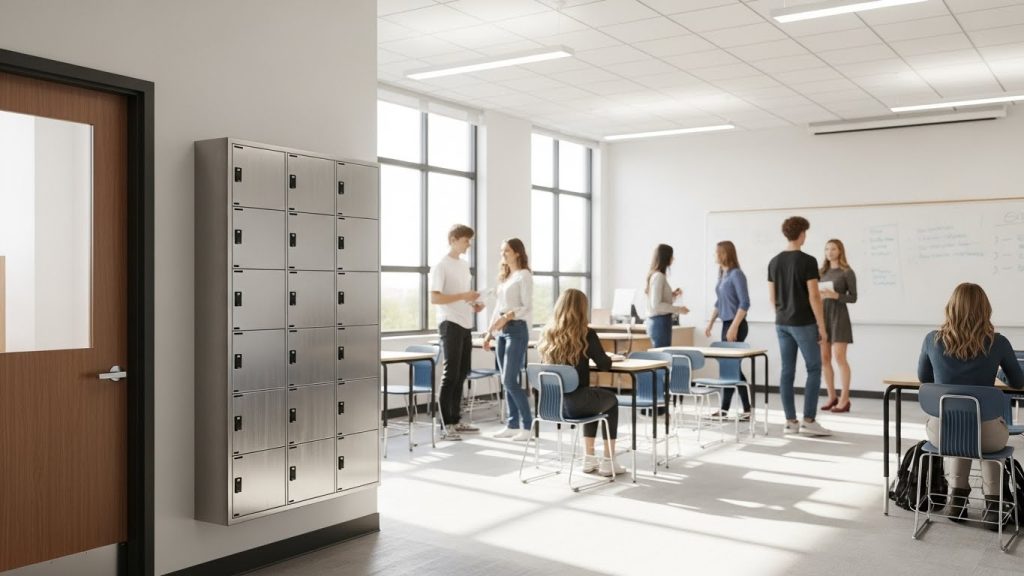
Every environment has a different "density" requirement. Use the following logic to determine your purchase order.
K-12 Classrooms (The 30+5 Rule)
For most secondary education settings, a single 30-slot unit is insufficient. The 30+5 Rule suggests purchasing 35 slots per classroom: 30 for the maximum student capacity, 2 for instructors, and 3 for visitors or students with dual devices (e.g., a phone and a smart tablet).
Corporate Offices & R&D Labs
In high-security environments, how phone lockers improve data security and compliance is a primary concern. Because these areas often have shift changes, your capacity needs to account for the "overlap period." If 50 employees are leaving and 50 are arriving, you may momentarily need 100 slots to prevent bottlenecks at the security checkpoint.
Gyms & High-Traffic Public Areas
In these settings, turnover is high but unpredictable. A good rule of thumb is to provide slots for 20% of your total building occupancy at any given time. For a gym with a 200-person capacity, 40 slots is usually the baseline.
Modular vs. Fixed Units: Scaling Your Storage
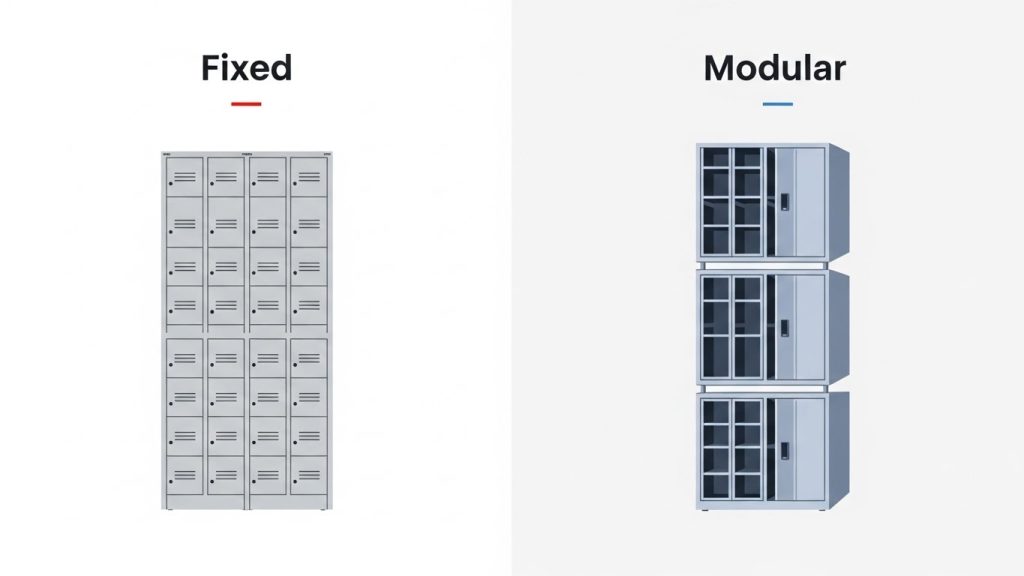
One of the most frequent questions in procurement is whether to buy one large cabinet or several smaller modules.
- Fixed Units: Often more cost-effective per slot. They provide a sleek, uniform look and are ideal when your headcount is stable.
- Modular Units: These allow you to "stack" capacity as you grow. You might start with 20 slots and add another 20-slot module next year. This flexibility is vital for growing startups or schools with fluctuating enrollment.
When calculating the budget for these configurations, consult a guide on how much cell phone lockers cost to understand how shipping bulkier fixed units compares to modular shipping rates.
Common Planning Pitfalls:
- Over-concentrating slots: Placing 200 slots in one narrow hallway creates a traffic jam during morning arrival. Distribute capacity across multiple smaller units if space allows.
- Neglecting ADA Compliance: Ensure that at least a portion of your locker slots are reachable (usually between 15" and 48" from the floor) for all users.
Frequently Asked Questions
Yes, most professional-grade phone lockers with a compartment width of at least 4 inches will accommodate an iPhone Pro Max or Samsung Ultra, even with a rugged case like an Otterbox.
Standard units typically come in configurations of 10, 20, 30, or 60 slots. Industrial-sized cabinets can be customized to hold up to 300+ slots in a single footprint.
Standard compartments are roughly 6 inches wide, 5 inches high, and 8 to 10 inches deep. These dimensions (needs verification) vary by manufacturer but are designed to fit nearly all handheld mobile devices.
You should purchase a 35 or 40-slot unit. This provides a buffer for teacher devices, guest speakers, and students who may need to store a second device or a bulky battery pack.
Standard "phone" lockers generally cannot hold full-sized tablets. If you need to store iPads or Surface Pros, you must look for "Tablet Lockers," which feature wider and deeper compartments (usually 12 inches or more).
While most slots are designed for one phone, some "family" or "multi-user" slots exist. However, for security and organization, a 1:1 ratio of phones to slots is highly recommended to avoid damage or theft.
For maximum accessibility, the top row of a wall-mounted locker should be no higher than 60 inches, and the bottom row should be at least 15 inches from the floor to meet standard reach guidelines.
