
What Sizes Do Cell Phone Lockers Come In? (2026 Guide)
Standard cell phone lockers typically feature "A" size doors measuring 6-1/2” W x 5-1/4” H or "B" size doors measuring 13” W x 5-1/4” H, with a standard depth of 8”. These dimensions are designed to accommodate modern smartphones, including large-format models with rugged cases, while maintaining a compact footprint for high-density storage.
In this guide, you will:
- Identify standard compartment dimensions for 2026 flagship devices.
- Calculate the total footprint for surface-mount and recessed units.
- Compare "Rough Opening" requirements for architectural planning.
- Avoid common installation mistakes that lead to ADA compliance issues.
Understanding Standard Cell Phone Locker Dimensions
When sourcing cell phone lockers, the industry categorizes sizes based on the door opening. While custom sizes exist, sticking to industry standards ensures easier replacement parts and predictable spatial planning.
- "A" Door (Small): Approximately 6-1/2” Wide x 5-1/4” High. This is the universal standard for individual phone storage.
- "B" Door (Large): Approximately 13” Wide x 5-1/4” High. These are twice the width of a standard door and are often used for "Mini" tablets or users who need to store a phone, wallet, and bulky keys together.
Common Mistake to Avoid: Don't assume the exterior door size is the usable interior space. The door frame and hinges typically reduce the "clear opening" by approximately 1/2" to 3/4" on the sides. Always verify the "clear opening" dimension to ensure a device can pass through the frame without scratching.
Individual Compartment Sizes: Will Your Device Fit?
As smartphone screen sizes have stabilized, the primary concern for 2026 is device thickness and the use of rugged, drop-proof cases. To ensure compatibility, you must consider the depth of the locker just as much as the height and width.
| Device Category | Typical Dimensions (w/ Case) | Recommended Door Size | Recommended Depth |
| Standard Smartphone | 3.2" W x 6.5" H | A Door | 5" or 8" |
| Large/Pro Max/Ultra | 3.6" W x 6.9" H | A Door | 8" (Preferred) |
| Foldable Phones | 3.2" W x 6.8" H (Folded: ~0.7" D) | A Door | 8" |
| Mini Tablets / E-Readers | 5.5" W x 8.0" H | B Door | 8" |
The Depth Factor: Standard units usually come in 5” or 8” depths. We strongly recommend the 8” depth for any facility where users might have thick protective cases or need to store additional personal items like a thick set of car keys or a wallet. Knowing how many phones a phone locker can hold depends heavily on whether you choose single or double-width compartments.
Popular Unit Configurations & Total Footprint
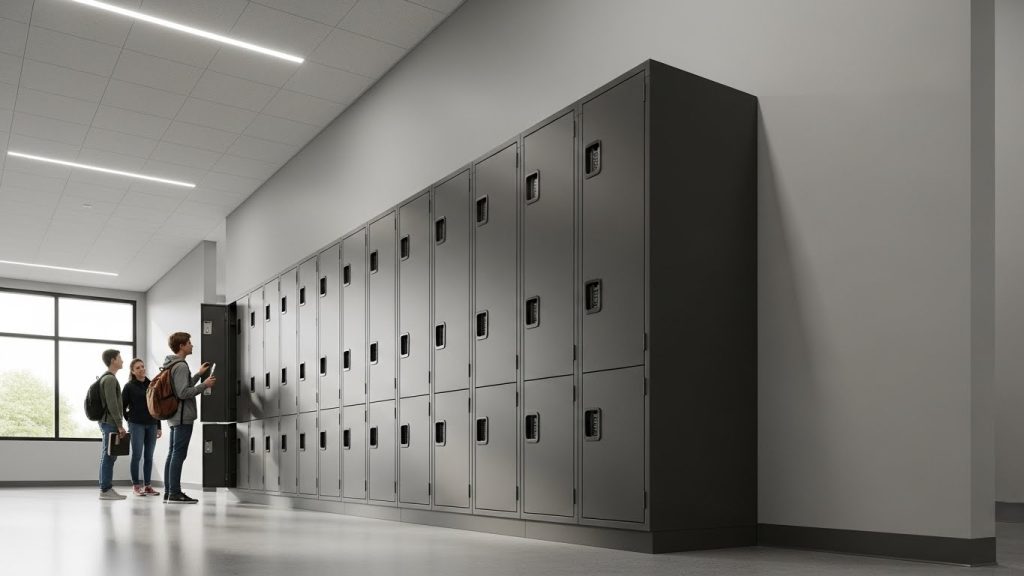
Cell phone lockers are rarely sold as single boxes; they are manufactured in "modules" or "enclosures." Understanding the total footprint is essential for hallway and lobby planning.
5-Door High Units (The "Compact" Choice)
A 5-high unit typically stands approximately 30" to 32" tall. These are ideal for mounting above existing furniture or in areas with limited vertical wall space. When stacked 3-wide (15 compartments total), the width is approximately 22" to 24".
7-Door High Units (The "High-Density" Choice)
The 7-high configuration is the most common for high-traffic environments like schools or manufacturing plants. Standing roughly 40" to 42" tall, these units maximize vertical space. A 5-wide, 7-high configuration can secure 35 phones in a horizontal span of less than 40".
Custom Modular Arrays
For large-scale deployments, modules can be bolted together. When planning these arrays, you must account for the outer master flange, which adds roughly 1" to 2" to the total width of the installation compared to the sum of the individual compartment widths.
Mounting Styles: Surface vs. Recessed Dimensions
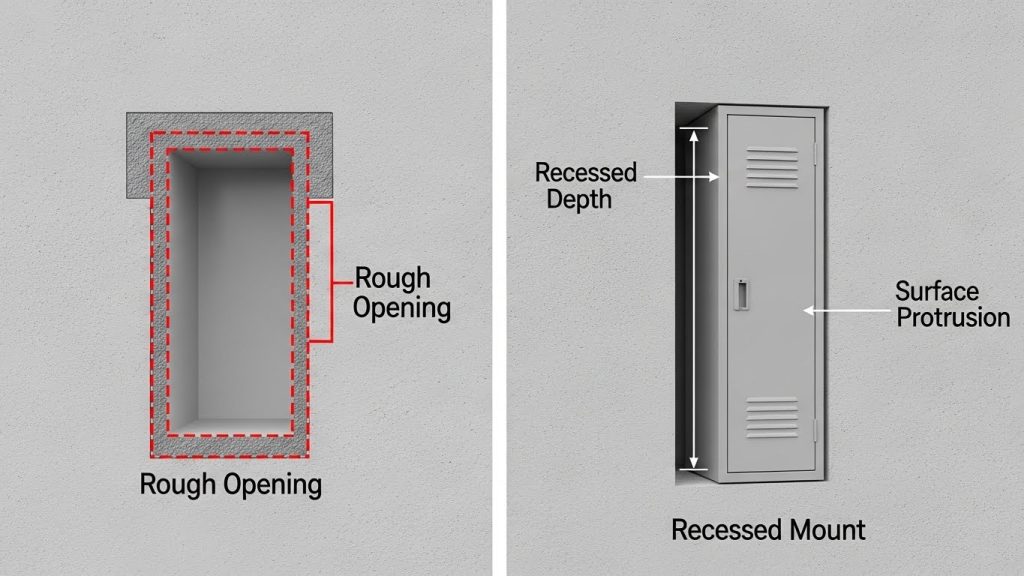
How you mount the unit determines the "visual" size and the architectural requirements.
- Surface Mount: The unit is bolted directly to the wall. The depth (usually 8") is fully visible.
- Constraint: In narrow hallways, an 8" protrusion may violate ADA (Americans with Disabilities Act) "Protruding Objects" rules.
- Recessed Mount: The unit is tucked into a wall cavity. Only the 1" to 2" thick flange and doors remain visible.
- Architectural Requirement: You must provide a "Rough Opening" (RO). A standard RO is typically 2-1/4" smaller in width and height than the unit's overall finished size (needs verification per specific model).
Common Mistake to Avoid: Ordering recessed units without checking for plumbing or electrical lines behind the drywall. If the wall cavity is not at least 8" deep, a semi-recessed mounting kit may be required.
Charging vs. Non-Charging Locker Sizes
If you are wondering what smart phone lockers are and how they work, the primary difference in sizing often involves the "power plenum."
- Integrated Power: Charging lockers often require a 1" to 2" deeper frame to accommodate internal USB-C wiring and power strips.
- Cable Management: Ensure the compartment depth allows for the phone to sit comfortably without the charging cable being bent at a sharp 90-degree angle against the door.
For more detailed financial planning on these units, see our guide on how much cell phone lockers cost.
FAQ: Common Questions on Locker Specs
The most common configurations are 5-high and 7-high units. These are typically available in widths of 1, 2, 3, 4, or 5 compartments, allowing for arrays ranging from 5 to 35 lockers per module.
Standard 8" deep lockers generally do not fit full-sized tablets (like a 12.9" iPad). However, they can accommodate "Mini" tablets if you use a "B" size (double-wide) door.
The rough opening is the hole cut into the wall. It is typically 1/2" larger than the locker enclosure but 2" smaller than the outer decorative flange to ensure a clean, covered finish.
To meet ADA requirements, the highest operable part of the locker (the lock or handle) should typically not exceed 48" from the finished floor for a front reach.
To meet ADA requirements, the highest operable part of the locker (the lock or handle) should typically not exceed 48" from the finished floor for a front reach.
Yes, a standard "A" door (6.5" wide) easily accommodates rugged cases. However, ensure you select the 8" depth to allow the door to close without pressing against the screen.
Most manufacturers allow for a "custom mix" where one module contains both "A" doors for phones and "B" doors for larger personal items or tablets.
Conclusion
Selecting the right size for your cell phone lockers is a balance between device compatibility and available wall space. For most 2026 facilities, a 7-high, 8-inch deep unit with "A" size doors provides the best density while ensuring that even the largest modern smartphones fit comfortably.
