
Scooter Locker vs Scooter Rack: Which is Better for Storage?
The scooter locker vs scooter rack debate is exploding for a simple reason: e-scooters are everywhere. As a facility consultant, I see this in every project. Campuses, offices, and apartments are flooded with them. They are left blocking doorways, cluttering hallways, and creating fire hazards.
This creates a new, urgent storage problem. How do you store these devices? They are expensive, a high theft risk, and they all have lithium-ion batteries that need charging.
This guide will give you the direct answer. A scooter locker is a high-security, private vault. It is the best solution for secure, weatherproof, and fire-safe storage. A scooter rack is a low-cost, high-density organizer. It is a simple stand to park multiple scooters.
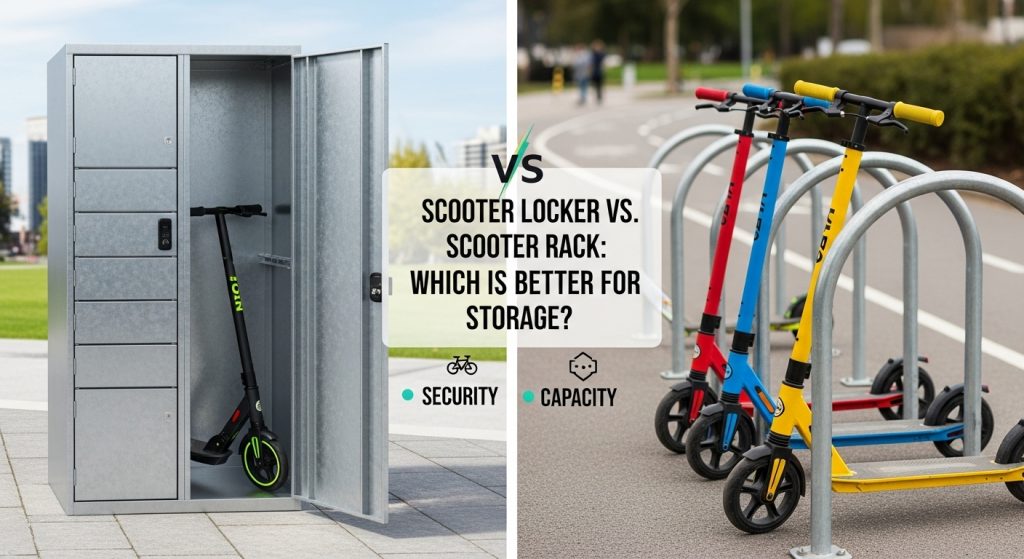
One is a total solution. The other is a parking spot. Choosing the right one is critical for your property's safety and your users' peace of mind.
Scooter Locker vs Scooter Rack: The Quick Answer
Before we dive deep, let's get our definitions straight. These two products solve very different problems.
What Is a Scooter Locker?
A scooter locker is a fully enclosed, heavy-duty box designed to secure one or two scooters. It functions as a private, weatherproof safe. It features an integrated lock and often an internal power outlet. This allows you to lock the scooter, battery, and charger safely inside.
Think of it as a personal garage for your scooter. It is the top-tier, Class 1 storage solution. It completely hides the scooter from view.
What Is a Scooter Rack?
A scooter rack is a simple, open-air stand. It is designed to organize and park multiple scooters in a small space. It provides a frame or loop to which users can attach their own lock. It does not offer any security or weather protection on its own.
Think of it as a parking spot. Its main job is to create order and density. It is not a security device.
The Core Difference: Security vs. Scalability
The entire scooter locker vs scooter rack choice boils down to this:
- Scooter Locker: Prioritizes MAXIMUM SECURITY. It is an all-in-one solution for security, charging, and weather protection. It is, however, expensive and has a low capacity.
- Scooter Rack: Prioritizes MAXIMUM DENSITY. It is a low-cost component. It allows you to park many scooters in a small footprint. It offers zero security or weather protection.
The #1 Factor: Security (Theft Protection)
This is the most important part of the discussion. E-scooters are a prime target for thieves. They are valuable, portable, and easy to sell.
The Security of a Scooter Locker
A locker is a "proactive" security system.
- Total Concealment: This is its greatest strength. A thief cannot see the scooter. They do not know its value. This "out of sight, out of mind" principle is a powerful deterrent.
- Integrated Lock: The security is not reliant on the user. The locker has its own heavy-duty, integrated lock. A thief would need loud, heavy power tools to breach it.
- Component Protection: The entire scooter, including its battery and display, is locked away. This prevents the casual theft of parts.
- Charger Protection: The user's $50-$150 charger is also locked safely inside.
A scooter locker is a vault. It is the correct solution for any area with public access.
The Security of a Scooter Rack
A rack is a "passive" system. It offers zero security on its own.
- Total Exposure: The scooter is in plain view. A thief can instantly see its brand and value. It is an advertisement for a high-value target.
- Relies on User's Lock: Security is 100% dependent on the user. If they use a cheap cable lock, the scooter can be stolen in seconds.
- Vulnerability: A thief can easily cut a lock, or even just unbolt the rack from the ground if it is poorly installed.
- Charger Theft: This is a major, unsolved problem. You cannot use a rack as a charging station if the user's charger is left exposed on the floor.
Security Winner: The Scooter Locker
This is not a fair fight. A scooter locker is a security solution. A scooter rack is an organization tool. For protecting an expensive asset, the locker is the only real choice.
The E-Scooter Problem: Charging & Fire Safety
Unlike most bikes, all e-scooters have a large lithium-ion battery. This introduces two new problems: the need for charging and the risk of fire.
Why E-Scooter Charging Is a Fire Risk
Lithium-ion batteries are a fire risk. This is a fact. The risk is highest when the battery is charging. If a user has a damaged battery, or uses a cheap, uncertified third-party charger, the battery can go into "thermal runaway."
This is not a normal fire. It is an explosive, self-sustaining chemical reaction. It releases toxic smoke and is almost impossible to put out with a standard extinguisher. Having 20 of these charging in a hallway is a building manager's worst nightmare.
How Lockers Provide Safe, Secure Charging
A charging locker provides a secure, internal power outlet. Users can lock their scooter and their personal charger inside the weatherproof unit. This protects the entire charging system from theft and rain. High-end lockers also offer fire-rated materials, designed to contain a potential battery fire.
This is a complete, insurable solution.
- Secure Outlet: The power outlet is inside the locked box.
- Charger Protection: The user's charger is safe from theft.
- Fire Containment: This is the key. Fire-rated lockers are designed to contain a thermal runaway event. They are built with fire-resistant materials and often have thermal fuses that cut power if the temperature gets too high.
- Ventilation: Many are vented, often to the outside. This removes toxic smoke from the building during a fire event.
A charging locker is an active safety system. It is designed to manage the worst-case scenario.
The Charging Rack Problem
A rack does not solve the charging problem. It often makes it worse.
- Where is the outlet? You can install outlets on the wall, but this is a mess of cables.
- Where is the charger? As mentioned, the user's charger is exposed to theft.
- Zero Fire Containment: A rack system has no fire safety features. It is just a collection of batteries charging in an open room. One faulty battery can ignite all the others.
This is a passive system. It relies 100% on the user having a perfect battery and charger. This is a risk many properties are no longer willing to take.
Fire Safety Winner: The Charging Bike Locker
The locker is the only solution that actively addresses fire safety. It contains the risk, protecting the building and other users.
Space & Density: Which is Better for Storage?
This is the question from the title. The answer depends on your definition of "better." Is it density or flexibility?
The Case for Racks: Maximum Density
A scooter rack is the undisputed champion of density.
- Small Footprint: Scooters are narrow. A rack can park them with just 12-18 inches of space per unit.
- High Scalability: You can fit 10 scooters on a rack in the same space it would take to fit 2-3 lockers.
- Low Cost: Racks are simple and cheap.
If your only goal is to park the maximum number of scooters in a small footprint for the lowest cost, a rack is the winner.
The Case for Lockers: Secure, Flexible Storage
A locker is a space loser on a per-scooter basis. There is no way around it. It is a large, heavy box for one scooter.
So why choose it? Flexibility of placement.
- No Secure Room Needed: A rack is only useful inside an already secure, locked room. A locker is the secure room.
- Outdoor Use: You can bolt a locker to any concrete pad. It is weatherproof. You cannot put a rack outside and expect the scooters to be safe or dry.
- Freestanding: A locker can be placed in a parking garage, on a plaza, or in a building lobby. It creates secure storage out of thin air.
A rack is a component. A locker is a solution.
So, Which is Better for Storage?
Which storage is better, a locker or a rack? A scooter rack is better for high-density storage, allowing you to park many scooters in a small, secure indoor room. A scooter locker is better for high-security storage, providing a complete, weatherproof, and lockable solution that can be placed anywhere.
The rack saves space horizontally. The locker creates secure space where none existed.
Weather Protection: Protecting Electronics
This is a simple but critical difference. E-scooters are electric vehicles. They have batteries, displays, and sensitive electronics.
Lockers: The All-Weather Solution
A locker is a sealed, weatherproof container. It provides 100% protection from:
- Rain and Snow
- Direct Sun (UV rays that degrade components)
- Dust and Pollen
- Humidity
This is not just for convenience. It is for asset protection. Electronics and water do not mix. A locker keeps the scooter clean, dry, and safe.
Racks: Total Exposure
A rack is an open-air stand. It offers zero protection. A scooter parked on a rack is exposed to every element. Even if you place racks under a simple bike locker vs bike shelter, they are still exposed to driving rain, dust, and humidity.
This is a key reason why racks are an "indoor only" solution.
Cost Analysis: Locker vs. Rack
This is often the deciding factor for property managers.
The Cost of a Scooter Locker
A locker has a high upfront cost and a high cost-per-scooter.
- What you are paying for: You are buying a heavy-duty, pre-built piece of secure furniture. It includes steel, a high-security lock, and often a UL-listed electrical system.
- The Value: The cost is all-inclusive. You are paying for the security, the weatherproofing, the fire safety, and the charging solution all in one.
The Cost of a Scooter Rack
A rack has a low upfront cost and a low cost-per-scooter.
- What you are paying for: You are buying a simple, bent piece of metal.
- The "Hidden Cost": The low price is deceptive. A rack is useless on its own. The true cost of a rack system is the cost of the racks plus the cost of the secure, locked, fire-rated room you must build to put them in.
What is the cost difference between a scooter locker and rack? A scooter locker has a very high cost per unit. A scooter rack has a very low cost per unit. However, the true cost of a rack system must include the cost of the secure, locked room it is in. A locker is an all-in-one solution with a higher upfront price.
When you factor in the cost of building a dedicated, secure "scooter room," the price of a few freestanding lockers is often much cheaper.
Comparing to Other Storage (The "Bike" Analogy)
This entire scooter locker vs scooter rack dilemma is a perfect parallel to the bicycle world. The logic is the same.
- A scooter rack is just like a basic bike rack. It is an anchor point, not a solution. We see this in the classic bike locker vs bike rack debate.
- A secure scooter room filled with racks is the same as a bike cage. This is a great, scalable model, as we explore in bike locker vs bike cage.
- Some may try to DIY a solution with a simple shed. But as the bike locker vs bike storage shed comparison shows, a shed has no default security or fire protection.
- This concept of a high-security, enclosed unit is well-established, as defined by the bicycle locker standard.
- Our bike locker comparison guide covers all these principles. The technology (bike vs. scooter) changes, but the principles of security and space do not.
The "Third Way": Battery-Only Lockers
Because scooter batteries are smaller and often removable, a new hybrid solution is perfect: the battery-only locker.
A popular hybrid is the battery-only locker. This is a wall-mounted bank of small, secure lockers with outlets inside. Users park their scooter at a cheap rack, but secure their expensive battery and charger in the locker. This is a cost-effective, scalable compromise.
This is a brilliant model.
- It Solves Security: It protects the two most stolen items: the battery and the charger.
- It Solves Fire Safety: The small, fire-rated lockers can contain a battery fire.
- It Solves Cost: It is far cheaper and more space-efficient than building full-sized lockers for every scooter.
The only downside is that the scooter frame itself is still left on a rack, but this is a minor risk compared to battery theft and fire.
How to Choose: A Checklist for Your Facility
Answer these simple questions to find your clear winner.
1. What is your #1 priority?
- A) Maximum Security & Fire Safety: You need to protect the asset and the building.
- Your Answer: Scooter Locker (or Battery Locker).
- B) Maximum Density & Low Cost: You just need to organize scooters and have a secure room.
- Your Answer: Scooter Rack.
2. Where will the storage be located?
- A) Outdoors, Public Area, or Unsecured Garage: The area is open to anyone.
- Your Answer: Scooter Locker.
- B) Indoors, in a Locked, Access-Controlled Room: Only tenants or employees can enter.
- Your Answer: Scooter Rack.
3. What are you storing?
- A) High-Value Personal Scooters: Users are leaving their $1,000+ devices for 8+ hours or overnight.
- Your Answer: Scooter Locker.
- B) Shared Fleet / Low-Value Scooters: This is a short-term "parking spot" for a shared fleet.
- Your Answer: Scooter Rack.
The Final Verdict
The scooter locker vs scooter rack debate is a choice between an all-in-one solution and a simple component.
You MUST Choose a Scooter Locker if:
- Security is your primary concern.
- You need to provide safe, secure charging.
- Fire containment is a legal or insurance requirement.
- The storage is outdoors or in a public-access area.
You SHOULD Choose a Scooter Rack if:
- Density (parking the max number of scooters) is your main goal.
- You already have a secure, locked, indoor room to put them in.
- You are on a very tight budget and are willing to accept the security and fire risks.
For almost every e-scooter application, a locker is the superior, safer, and more responsible choice. A rack is just an organizer, and it fails to solve the two biggest problems: theft and fire.
