
Metal vs Plastic (HDPE) Bike Lockers: Durability & Design Compared
The metal bike locker vs plastic/HDPE bike locker debate is one of the most fundamental choices a facility manager can make. As a security and planning consultant, I've seen this decision create long-term satisfaction or a long-term maintenance nightmare. You are not just buying a box; you are investing in a 20-year security and storage solution.
So, which one is better?
Metal bike lockers offer superior fire resistance and high brute-force security at a lower upfront cost. Plastic (HDPE) bike lockers offer total weather resistance, zero rust, low maintenance, and modern design options.
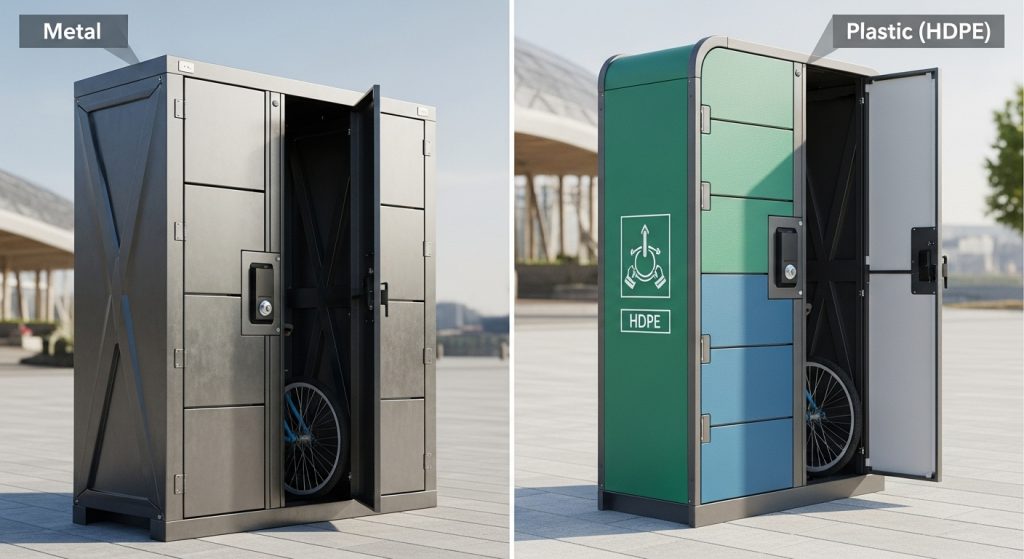
One is a traditional, heavy-duty vault. The other is a modern, resilient, "set it and forget it" solution. Choosing the wrong material for your environment is a costly mistake. This guide will compare them head-to-head on every factor that matters.
What Is a Metal Bike Locker?
A metal bike locker is the traditional standard for high-security bike parking. These are typically made from steel, which is then protected from the elements.
- Material: Most are made from heavy-gauge galvanized steel.
- Protection: The steel is almost always "powder-coated." This is a process where a dry powder is sprayed onto the metal and then baked in an oven. This creates a hard, durable, and colorful shell, much tougher than regular paint.
Metal lockers are known for their rigidity and strength. They are the "bank vault" of the bike parking world.
What Is a Plastic (HDPE) Bike Locker?
When we say "plastic," we are not talking about a flimsy garden shed. We are talking about High-Density Polyethylene (HDPE).4
- Material: HDPE is a structural, industrial-grade polymer. It is the same material used to make chemical tanks, playground equipment, and cutting boards.
- Manufacturing: These lockers are "rotationally molded." This process creates a single, seamless, and incredibly strong double-walled structure.
HDPE lockers are known for their resilience. They are designed to absorb impacts and resist the elements completely.
The Core Difference: Strength vs. Resilience
The entire metal bike locker vs plastic/HDPE bike locker choice comes down to one trade-off:
- A metal locker is rigid and strong. It resists being cut or breached. Its weakness is its surface; a scratch can lead to rust.
- A plastic (HDPE) locker is resilient and durable. It absorbs impacts and cannot rust or corrode.12 Its weakness is its lower melting point.
Durability: The Long-Term Test
Durability is not just about strength. It is about how a product endures its specific environment over time.
How Metal Lockers Handle Wear and Tear
Metal lockers are incredibly strong. They are difficult to puncture. However, their durability is tied to their coating.
- Dents and Scratches: Steel will dent upon heavy impact. A deep scratch that breaks the powder coating is a serious problem.
- Rust and Corrosion: Once that protective coating is breached, the steel underneath is exposed to air and moisture. Rust will set in. This is not just ugly; it compromises the structural integrity of the locker over time.
- Lifespan: In a dry, indoor environment, a metal locker can last for decades. In an outdoor, humid, or coastal environment, its lifespan can be cut in half.
How HDPE Lockers Handle Wear and Tear
HDPE lockers are built for resilience.17
- Impact Resistance: The double-walled, rotomolded design is made to absorb impacts. A baseball bat or a car door will bounce off. It will not dent or crack.
- Scratches: The color in an HDPE locker is not a coating. It is "compounded" through the entire material. A deep scratch will only reveal... more of the same color. It is impossible to scratch the "paint" off.
- Rust and Corrosion: HDPE is plastic. It is 100% rust-proof, waterproof, and resistant to most chemicals, including road salt. It is the ideal material for outdoor and wet-area use.
- Lifespan: A high-quality HDPE locker has an expected lifespan of 20+ years, even in the harshest outdoor conditions.
Durability Winner: Plastic (HDPE). For long-term, all-weather durability, an HDPE locker's inability to rust or dent gives it a clear advantage.22
Security: Protecting the Bike
This is a complex comparison. Both can be very secure, but they have different vulnerabilities.
The Security of a Metal Locker
Is a metal bike locker secure?
Yes. Metal bike lockers are extremely secure against brute-force attacks. The heavy-gauge steel is difficult to cut, drill, or pry open. Most feature high-security, multi-point locking systems. However, their security can be compromised over time if rust weakens the door, frame, or locking points.
Metal's rigidity is its greatest security asset.
The Security of a Plastic (HDPE) Locker
Is a plastic bike locker secure?
Yes, a high-quality HDPE locker is very secure. They are rotationally molded into a seamless, double-walled unit. This construction, combined with heavy-duty locks and hinges, makes them extremely difficult to pry open or "jimmy." They are also impervious to being smashed.
The misconception is that "plastic" is weak. Industrial-grade HDPE is tough and absorbs impact. Its seamless design leaves no weak points for a crowbar.
Security Winner: Tie. While metal feels stronger, a well-designed HDPE locker is just as secure against the most common forms of theft. Metal's security can degrade with rust, while HDPE's security is stable for life.
The Fire Safety Factor (The E-Bike Problem)
This is a new and critical factor. The rise of e-bikes means we are now storing lithium-ion batteries.
Metal Lockers and Fire
Are metal bike lockers fire-resistant?
Yes. This is metal's single greatest advantage. Steel is non-combustible and has an extremely high melting point.27 A metal bike locker will contain a lithium-ion battery fire, preventing it from spreading to other lockers or the building itself. This is a critical safety feature.
Plastic (HDPE) Lockers and Fire
Are plastic bike lockers flammable?
Yes. HDPE is a polymer (a plastic) and it will burn when exposed to a direct flame. It is not a fire-containment solution. If an e-bike battery goes into thermal runaway inside an HDPE locker, the locker itself will likely be consumed and the fire will spread.
Fire Safety Winner: Metal. If you are creating a charging bank or storing e-bikes, the non-combustible nature of a metal locker is a vital safety advantage.28
Weather & Climate: The Real-World Test
A bicycle locker is often placed outdoors. This is where the materials truly show their differences.
Metal in the Elements
- Rain and Humidity: This is metal's enemy. Even the best powder coating can have microscopic pinholes. Moisture will find a way in. In coastal areas, the salt air is extremely corrosive and will accelerate rusting.29
- Sun and Heat: Metal is a conductor. In direct sun, a metal locker will become an oven. Temperatures inside can exceed 150°F (65°C). This can damage plastic bike components, degrade grips, and be dangerous to the touch.
- Cold: Metal gets extremely cold and can be brittle.
Plastic (HDPE) in the Elements
- Rain and Humidity: HDPE is 100% waterproof. It cannot rust, corrode, or rot. It is the perfect material for poolsides, coastal towns, and rainy climates.
- Sun and Heat: HDPE is an insulator, not a conductor. It does not transfer heat. While it will get warm, the interior will remain much closer to the ambient temperature. This protects the bike inside.
- UV Resistance: High-quality HDPE is compounded with UV stabilizers. This prevents the color from fading or the material from becoming brittle in the sun.
- Cold: HDPE remains durable and resilient even in freezing temperatures.
Weather & Climate Winner: Plastic (HDPE). It is a clear winner for any outdoor application.
Cost: Upfront vs. Long-Term Value (ROI)
Your budget is a key driver. Here, the answer is split.
The Upfront Cost
Which is cheaper, a metal or plastic bike locker?
A metal bike locker almost always has a lower upfront purchase price. Steel is a common and less expensive material to manufacture with. The advanced rotational molding process and higher-grade polymer make HDPE lockers more expensive to produce.
This is a key comparison in our bike locker vs bike rack cost analysis. A locker of any kind is a premium purchase over a simple rack, but metal is the cheaper locker option.
Upfront Cost Winner: Metal.
The Long-Term Cost (Total Cost of Ownership)
This is the metric that facility managers truly care about.
- Metal Locker: Requires a budget for maintenance.36 This includes sanding and repainting scratches to prevent rust. In 10-15 years, an outdoor metal locker may need to be replaced entirely.
- Plastic (HDPE) Locker: Requires virtually zero maintenance.37 It just needs to be hosed off. Its 20+ year lifespan means you buy it once.
Over a 20-year period, buying one HDPE locker is almost always cheaper than buying one metal locker and paying to maintain it, or replacing it entirely.
Long-Term Cost Winner: Plastic (HDPE).
Design, Aesthetics & Maintenance
How the locker looks and how hard it is to maintain are key to a property's appeal.
Design and Appearance
- Metal: Tends to look very industrial and rigid. Colors are limited to the powder-coat selection. The finish can chip, fade, and show rust.
- Plastic (HDPE): Can be molded into modern, seamless shapes with rounded corners. The color is integral and vibrant. It offers a much wider range of colors that can match a building's brand.
Maintenance and Cleaning
- Metal: Difficult. Rust needs to be treated. Dents are permanent.
- Plastic (HDPE): Easy. It is naturally graffiti-resistant (spray paint and markers wipe off). It is non-porous, so dirt and grime hose right off. It is the "low-maintenance" champion.
Design & Maintenance Winner: Plastic (HDPE).
Quick Comparison: Metal vs. Plastic (HDPE)
| Feature | Metal Bike Locker (Steel) | Plastic Bike Locker (HDPE) |
| Durability | Good (Strong but dents) | Excellent (Resilient, no dents) |
| Security | Excellent (Brute force) | Excellent (Seamless design) |
| Fire Safety | Excellent (Non-combustible) | Poor (Flammable) |
| Weather | Poor (Rusts, gets very hot) | Excellent (Waterproof, insulated) |
| Upfront Cost | Lower | Higher |
| Long-Term Cost | Fair (High maintenance) | Excellent (Low/no maintenance) |
| Maintenance | High (Rust, paint chips) | Very Low (Wipe/hose clean) |
| Aesthetics | Industrial, limited colors | Modern, wide color range |
| Weight | Very Heavy | Lightweight (Easier install) |
Where Do Lockers Fit in Your Storage Plan?
A locker is the top-tier, Class 1 solution. It is a premium choice. It is important to know when you need one.
- Locker vs. Rack: A bike locker vs bike rack is not a fair fight. A rack is just a pole. A locker is a complete security and weather solution.
- Locker vs. Shelter: A bike locker vs bike shelter is a choice of security. A shelter protects bikes from rain but offers zero theft protection. A locker protects from both.
- Locker vs. Cage: A bike locker vs bike cage is private vs. communal security. A cage is a great indoor solution, but a locker provides individual, weatherproof security that can be placed anywhere.
- Locker vs. Shed: A bike locker vs bike storage shed is a comparison of security. A shed is a low-security "box," while a locker is a purpose-built vault.
For a full breakdown of every option, see our complete bike locker comparison guide.
The Final Verdict: Which One Should You Buy?
The choice in the metal bike locker vs plastic/HDPE bike locker debate is clear once you define your primary need.
You MUST Choose a Metal Bike Locker if:
- Fire safety is your #1 concern. This is the deciding factor for storing e-bikes or for installation against a residence.
- Your lockers will be indoors, in a dry, climate-controlled area (like a parking garage).
- Low upfront cost is your most important budget metric.
You MUST Choose a Plastic (HDPE) Bike Locker if:
- The lockers will be outdoors, in any climate.
- You are in a wet, humid, or coastal area (where rust is a major problem).
- Low long-term cost and zero maintenance are your main goals.
- You want modern aesthetics and a wide range of color options.
My professional advice is this: For any outdoor use, the total weather immunity of HDPE makes it the superior long-term investment. For any indoor e-bike charging, the fire-containment of metal is the only responsible choice.
