
What’s the Best Phone Locker Layout for Hallways and Entrances?
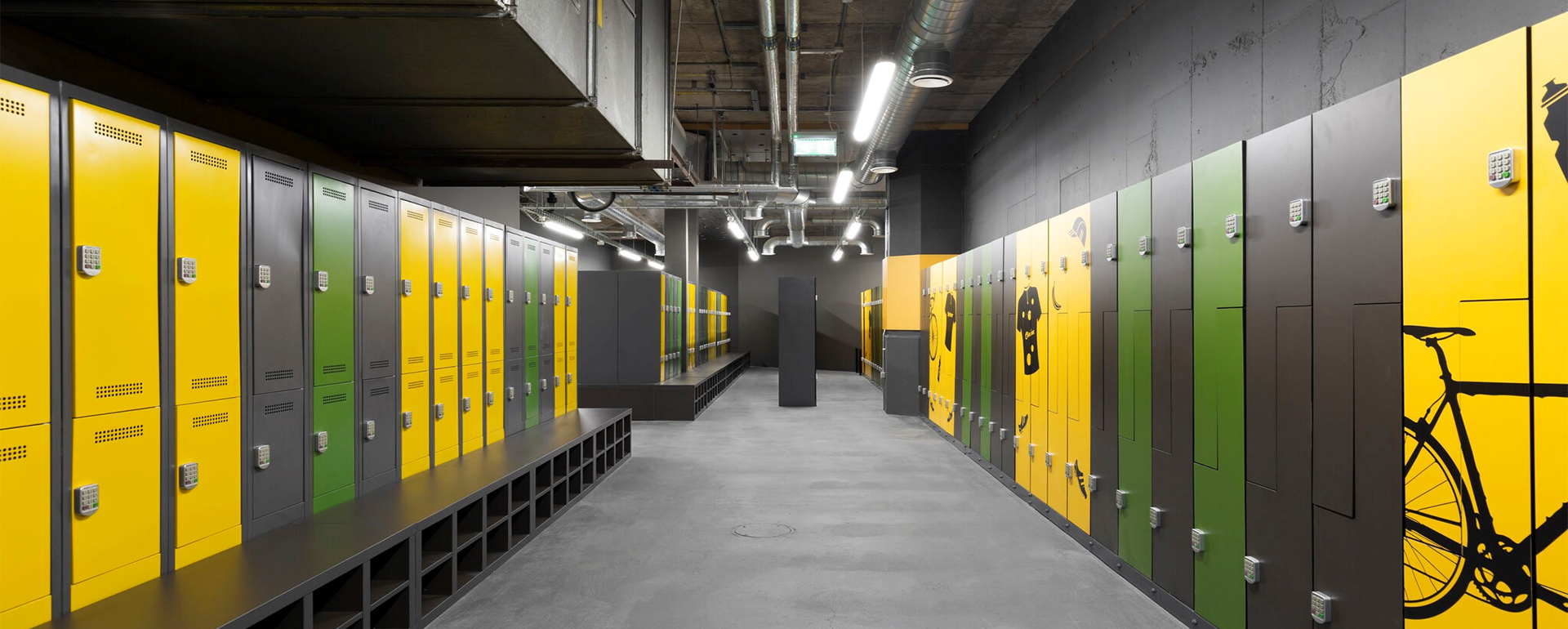
The best phone locker layout for hallways is a recessed linear configuration mounted at a height of 15 to 48 inches to ensure floor space optimization and ADA compliance. For high-density entrances, a staggered "pod" layout is more effective, as it prevents traffic bottlenecks by allowing multiple users to access their devices simultaneously without blocking the main corridor.
In this guide, you will learn how to:
- Calculate the "30-Second Access" flow for high-traffic zones.
- Choose between recessed and surface-mount technical specifications.
- Implement 2026 ADA height and reach standards.
- Configure integrated charging and security line-of-sight.
1. Traffic Flow: The "30-Second Access" Strategy
In schools and corporate offices, phone lockers face "burst" traffic—hundreds of users attempting to store or retrieve devices within a 5-minute passing period. To prevent hallway congestion, your layout must facilitate what we call the "30-Second Access" strategy. This ensures that a user can reach their locker, authenticate, and move on without stopping the flow of others behind them.
Linear layouts are traditional, but in narrow hallways, they often create "standing waves" of people. If your facility has the space, staggered layouts or "Entrance Pods" are superior. These pods involve grouping cell phone lockers in alcoves or nooks away from the primary walking path. This design allows for a "pull-off" lane, similar to a highway shoulder, keeping the main hallway clear for transit.
Example Layouts:
- The Pocket Layout: Carving out small 3-foot deep nooks in the hallway wall every 20 feet.
- The Gateway Layout: Large-capacity locker banks situated in the foyer immediately following the security turnstiles.
Common Mistakes to Avoid:
- Dead-End Placement: Never place high-density lockers at the end of a narrow corridor where users can get trapped.
- Corner Crowding: Placing units too close to 90-degree turns, which creates an immediate "blind" bottleneck.
2. Technical Specs: Recessed vs. Surface Mount
Choosing the mounting style is a critical decision for fire code compliance and aesthetics. In 2026, many building codes require a minimum clear hallway width of 48 inches (needs verification for specific local jurisdictions). If your hallway is narrow, surface-mounted lockers might protrude too far, violating safety regulations.
Recessed mounting is the gold standard for modern hallway design. By installing the locker unit inside a wall cavity, you save 8 to 12 inches of corridor width. However, this requires careful coordination with structural engineers to ensure the wall is not load-bearing or that a proper header is installed. Surface mounting is faster and more cost-effective for retrofits, but it requires "sloping hoods" on top of the units to prevent dust accumulation and the placement of unauthorized items.
| Feature | Recessed Mount | Surface Mount |
| Space Savings | Maximum (0" protrusion) | Minimal (Protrudes 8-12") |
| Installation Cost | Higher (Requires wall cutting) | Lower (Direct wall anchor) |
| Aesthetics | Clean, integrated look | Industrial, modular look |
| Maintenance | Low (No exposed top surface) | Moderate (Requires dusting hoods) |
When planning these installs, consider if the units are sized correctly; can phone lockers store tablets and small devices too? If so, your wall cavity depth may need to increase to accommodate the deeper chassis.
3. Legal Compliance: 2026 ADA Locker Height Requirements
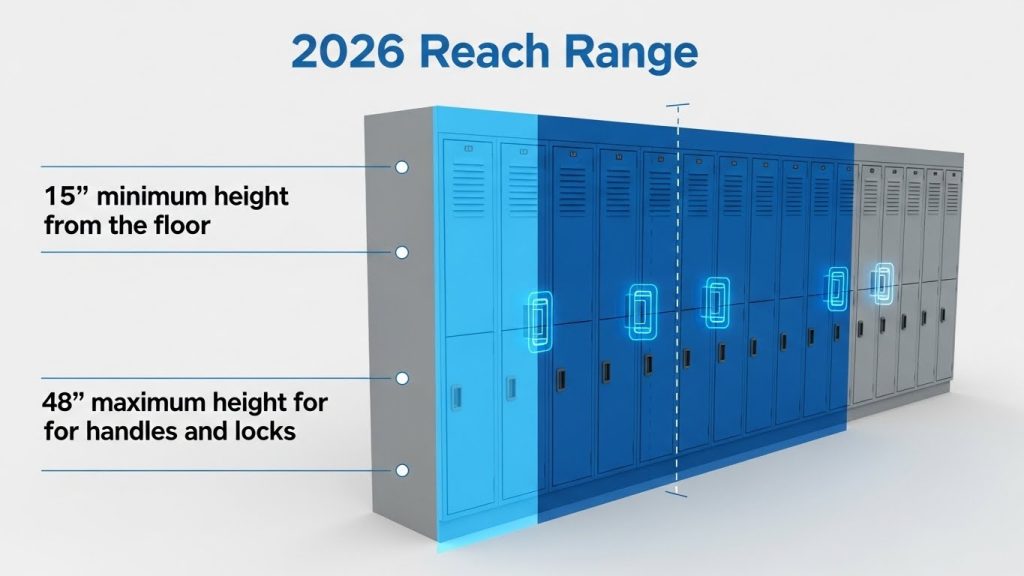
Accessibility is not optional. Under the latest ADA standards, a percentage of your locker bank—typically 5%—must be accessible to users in wheelchairs. This dictates a strict "Reach Range" for your layout.
The maximum high forward reach should be 48 inches from the finished floor, and the minimum low reach should be no lower than 15 inches. Furthermore, the hardware (locks or handles) must be operable with one hand without tight grasping, pinching, or twisting of the wrist. For 2026 facilities, we recommend "The Accessible Zone" layout, where all locker banks are kept within this 15–48 inch vertical window to ensure 100% of the units are usable by everyone.
Common Mistakes to Avoid:
- Top-Row Only Access: Placing all small lockers above 5 feet, making them unreachable for many users.
- Obstruction: Placing lockers behind a "bench" or curb that prevents a wheelchair from getting close enough for a side-reach.
4. Power & Connectivity: Integrated Charging Layouts
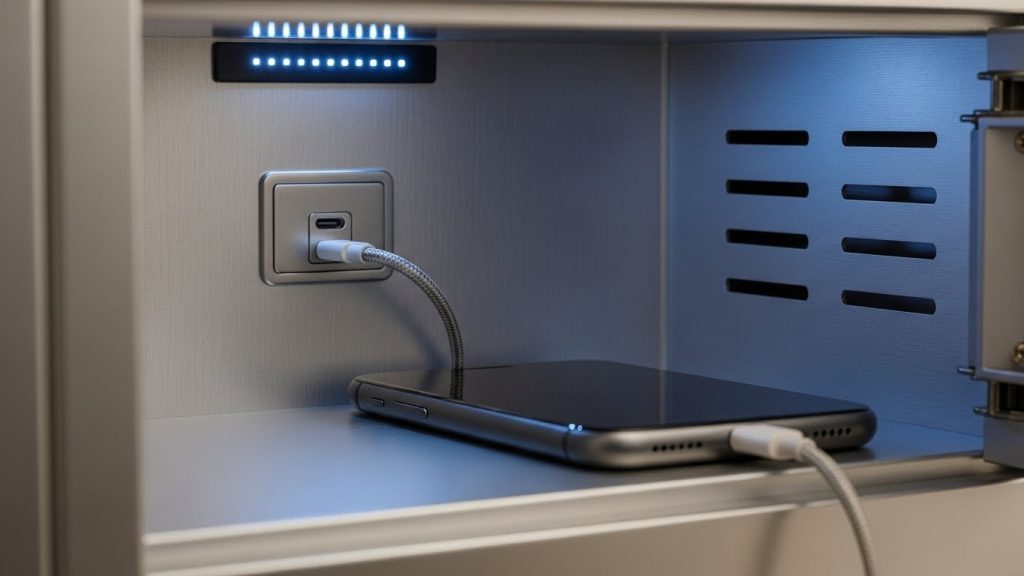
The shift toward "Digital Wellbeing" policies means lockers are no longer just for storage—they are charging hubs. When designing a layout with integrated power, ventilation becomes your primary technical challenge. Smartphones and tablets generating heat while charging in an enclosed space can lead to battery degradation or thermal throttling.
Your layout must include rear-panel clearance or integrated fans for airflow. In 2026, we focus on energy-efficient "Smart Charging" where power is only delivered when a device is detected. Before finalized the wiring, ensure you have reviewed what security features should a phone locker system include? because high-end electronic locks and charging systems often share the same power bus.
Mini-Template for Charging Hubs:
- Power Source: Dedicated 20A circuit for every 60–80 charging ports.
- Cabling: Use "Daisy-Chain" rear wiring to minimize the number of external wall outlets needed.
- Heat Dissipation: Ensure at least 2 inches of "air-gap" behind surface-mounted units.
5. Security vs. Privacy: Visibility Layouts
The "Line of Sight" is the most effective deterrent against tampering. The best layout is one that allows for natural surveillance. This means lockers should be visible from a supervisor's desk or within the direct path of security cameras.
However, you must balance this with user privacy. Users do not want their passcodes or facial recognition patterns easily "shoulder-surfed" by others in the hallway. Using an Angled Layout (where locker faces are turned 15 degrees away from the main walking path) can provide enough privacy for the user while still keeping the units visible to overhead security cameras.
To determine the scale of your security needs, first calculate your volume by asking how many phone lockers do you need for your headcount? This helps in deciding if you need a centralized "Locker Room" or distributed "Hallway Pods."
Common Mistakes to Avoid:
- Blind Spots: Placing lockers behind structural pillars or in darkened alcoves.
- Camera Obstruction: Installing surface-mounted units so high that they block the view of existing hallway security cameras.
FAQ
The best layout for narrow hallways is the recessed linear configuration. By embedding the units into the wall, you maintain the required clear-width for fire safety and traffic flow while providing high-density storage.
The minimum clear width is typically 48 inches (needs verification), though this can vary by local building code. You must measure from the outermost point of the locker (including handles/locks) to the opposite wall.
Phone lockers only need a power source if they include integrated USB-C/Wireless charging or electronic keypad locks. Standard key-operated or mechanical combination lockers do not require electricity.
The maximum high reach for a locker control or door handle is 48 inches from the floor. This ensures that the unit is accessible to individuals in wheelchairs or those with limited reach.
You can prevent shoulder surfing by using privacy shields on keypads or by arranging the lockers in an angled "sawtooth" layout. This prevents people walking by from easily seeing the code being entered
Yes, but you must ensure the lockers do not reduce the required egress width. Additionally, recessed lockers must be installed without compromising the fire-rating of the wall assembly, often requiring specialized fire-rated enclosures.
Conclusion
The "best" layout is one that balances high-speed traffic flow with strict adherence to ADA and fire safety standards. Whether you choose the space-saving benefits of recessed mounting or the modular flexibility of surface-mounted pods, your priority should be the user's ability to store and retrieve their device in under 30 seconds.
