
Are Phone Lockers ADA Compliant and Accessible?
Yes, phone lockers are ADA compliant only if they meet specific mounting heights, operational requirements, and quantity standards. To be accessible, at least 5% of your lockers must be installed within the 15" to 48" reach range and feature locks that do not require tight grasping or twisting.
What you’ll control in this guide:
- Identify the exact "scoping" requirements for your facility.
- Master the mounting heights to avoid costly re-installation.
- Select the right lock types for "one-handed" operation.
- Prepare for the 2026 Digital Accessibility mandates for smart lockers.
What Makes a Cell Phone Locker ADA Compliant?
ADA compliance for storage isn't just about the box itself; it’s about how that box is integrated into the environment. Under the 2010 ADA Standards for Accessible Design, cell phone lockers are categorized under Section 225 (Storage) and Section 811 (Storage Elements).
To be fully compliant, a locker system must address three distinct pillars:
- Clear Floor Space: There must be a 30" x 48" level space in front of the locker to allow for a forward or side approach by a wheelchair.
- Reach Range: The locker's opening and its locking mechanism must be accessible.
- Operability: The user must be able to open, use, and close the locker without needing to pinch or twist their wrist.
For example, a high-density bank of cell phone lockers might be physically sturdy, but if the keypad is mounted 60 inches high, it is legally inaccessible to many users.
The 5% Rule: How Many Accessible Units Do You Need?
The ADA doesn't require every single phone locker to be accessible, but it does require a specific percentage. According to Section 225.2.1, where lockers are provided, at least 5 percent (but no fewer than one) of each type must be compliant.
- Understanding "Type": If you offer two different models—such as one bank with USB charging and one bank without—you must provide at least one ADA-compliant unit for each model.
- The Cluster Rule: If you have lockers in multiple locations (e.g., the gym and the main lobby), the 5% rule applies to each cluster independently.
Common Mistake: Many facility managers assume that having one ADA locker in a bank of 100 is enough. If those 100 lockers consist of different sizes or features, you likely need more to meet the "one of each type" requirement.
Mounting & Reach Ranges (The 15" to 48" Rule)
The most common compliance failure involves mounting height. For a locker to be accessible, every "operable part"—including the handle, the coin slot, the keypad, or the keyhole—must fall within the unobstructed reach range.
Unobstructed Forward & Side Reach
For a standard wall-mounted phone locker, the "sweet spot" is between 15 inches and 48 inches above the finished floor (AFF).
- The High Limit: No part of the lock or handle can be higher than 48 inches.
- The Low Limit: The lowest shelf or operable part cannot be lower than 15 inches.
When installing a vertical stack of five or six lockers, typically only the middle rows will be ADA-compliant. The top rows are usually too high, and the very bottom row may be too low if it sits directly on the floor without a base or pedestal.
Operable Parts: Locks and Handles
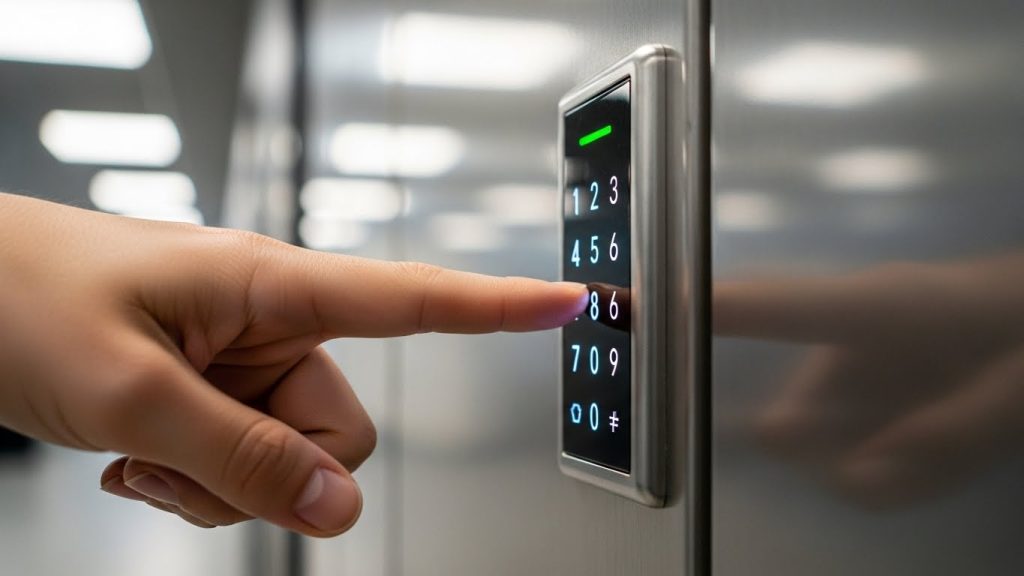
A locker is only as accessible as its lock. Section 309.4 states that operable parts must be usable with one hand and must not require "tight grasping, pinching, or twisting of the wrist."
- Compliant Locks: RFID readers, push-button keypads, and U-shaped pulls are generally compliant because they can be operated with a closed fist or a single finger.
- Non-Compliant Locks: Traditional circular combination dials are typically not ADA-compliant because they require fine motor skills and wrist twisting to align the numbers.
If your facility uses digital locks, security is paramount. Managers should know How Do You Reset a Digital Phone Locker Code Safely? to assist users while maintaining accessibility standards.
Common Mistake: Using a "paddle" latch that requires the user to pull and twist simultaneously. This violates the one-hand, no-twist rule.
NEW FOR 2026: Digital Accessibility for Smart Lockers
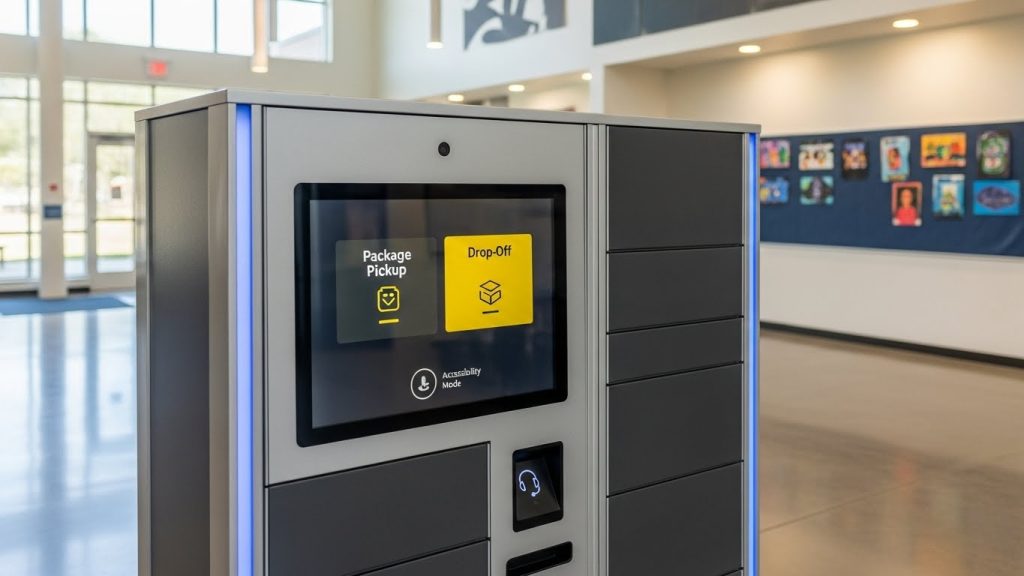
As we move into 2026, the definition of "access" is expanding. The ADA Title II updates now specifically address digital interfaces provided by public entities (like schools and local governments).
If your phone lockers use a central touchscreen kiosk:
- WCAG 2.1 Level AA: The software interface must meet these digital standards by April 2026.
- Contrast & Speech: The screen must provide high color contrast and, ideally, haptic or audio feedback for visually impaired users.
- Reach: The screen itself must be mounted within the 15"–48" range.
Failing to provide a digital fallback—like an RFID card option for those who cannot use a touchscreen—could lead to compliance issues under the new "accessible by default" mandate.
FAQ: Common Compliance Questions
The maximum height for any operable part (the lock, handle, or keypad) is 48 inches above the finished floor.
While the ADA doesn't strictly mandate Braille on every individual locker, Section 216 requires that permanent room signs and certain directional signs have raised characters and Braille. Labeling at least your ADA-compliant units with tactile numbers is highly recommended.
You must provide at least 5% of the total number of lockers, but never fewer than one of each type provided.
Standard padlocks are generally not compliant because they require pinching and twisting. However, specialized ADA padlocks with large "key-heads" that allow for a flat-hand grip may be acceptable.
If a locker is assigned outside of the reach range, the facility is out of compliance. It is best to have a policy in place for What Happens If Someone Forgets a Locker Code or Loses a Key? to ensure staff can quickly relocate a user to a compliant unit.
The ADA recommends centering the 30"x48" space on the locker, but it is not a strict requirement as long as the space allows the user to reach all operable parts.
Conclusion
Ensuring your phone lockers are ADA compliant is a blend of choosing the right hardware and executing a precise installation. By adhering to the 15"–48" mounting rule and selecting one-handed digital locks, you protect your facility from liability and provide a seamless experience for all users.
