
Can Phone Lockers Store Tablets and Small Devices Too?
Most standard cell phone lockers are designed specifically for smartphones and will not fit full-sized tablets like the iPad Pro or Surface Pro. However, hybrid locker models with larger compartments (typically 12 inches or wider) are specifically built to secure both phones and tablets in a single unit.
In this guide, you will learn:
- How to calculate the "true clearance" needed for devices with rugged cases.
- Which specific tablet models fit into standard vs. large-compartment lockers.
- The power and wattage requirements for charging tablets in 2026.
- Thermal safety tips to prevent lithium battery overheating in enclosed spaces.
The Short Answer: Size Matters (Dimensions Breakdown)
When evaluating cell phone lockers, the primary constraint is the clear opening of the door. While a locker might have a generous internal cavity, a narrow door frame can prevent a tablet from sliding in. Standard phone lockers usually offer a door width of 6 to 7 inches, which is perfect for even the largest smartphones but insufficient for a standard 10.2-inch iPad.
To accommodate a modern workforce or student body, procurement officers often shift to "B-size" or Tablet doors. These compartments typically offer a 12-inch to 15-inch width. It is also vital to consider depth; most phone locker materials are designed for a depth of 4 to 8 inches, which is plenty for a device but can become cramped if external battery packs or bulky keyboards are attached.
Common Mistakes to Avoid:
- Ignoring the Bezel: Measuring only the screen size (e.g., 10 inches) rather than the total exterior dimensions of the device.
- The "Naked" Device Fallacy: Failing to account for protective cases like Otterbox or UAG, which can add up to 0.75 inches to the width and thickness.
- Diagonal vs. Vertical: Tablets are often inserted at an angle to fit, which can scratch the screen if the locker interior isn't maintained or if you don't clean and sanitize phone lockers regularly to remove abrasive debris.
Compatibility Guide: Which Devices Fit Where?
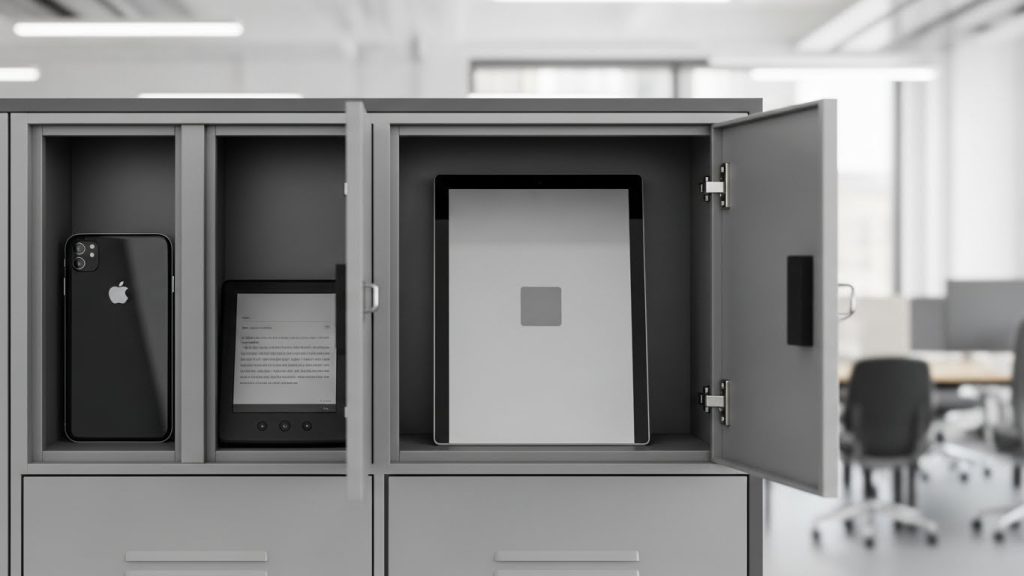
Navigating the landscape of 2026 mobile tech requires precise measurements. Below is a compatibility matrix based on standard locker dimensions.
| Device Category | Typical Dimensions | Fits in Standard Phone Locker? | Recommended Locker Type |
| Smartphones | Up to 6.8" x 3.1" | Yes | Standard Cell Phone Locker |
| E-Readers (Kindle) | 6.9" x 4.9" | Yes (Tight Fit) | Standard or Hybrid |
| Small Tablets (iPad Mini) | 7.69" x 5.3" | No (Usually) | Tablet / Hybrid Locker |
| Standard Tablets (iPad) | 9.79" x 7.07" | No | Tablet / Hybrid Locker |
| Large Tablets (iPad Pro 12.9) | 11.04" x 8.46" | No | Large Format Device Locker |
When selecting a locker, ensure you have at least 1 inch of "wiggle room" around the perimeter of the device. This prevents users from jamming devices against the metal edges, which can lead to screen cracking or frame bending.
Charging & Power: Beyond the Physical Fit
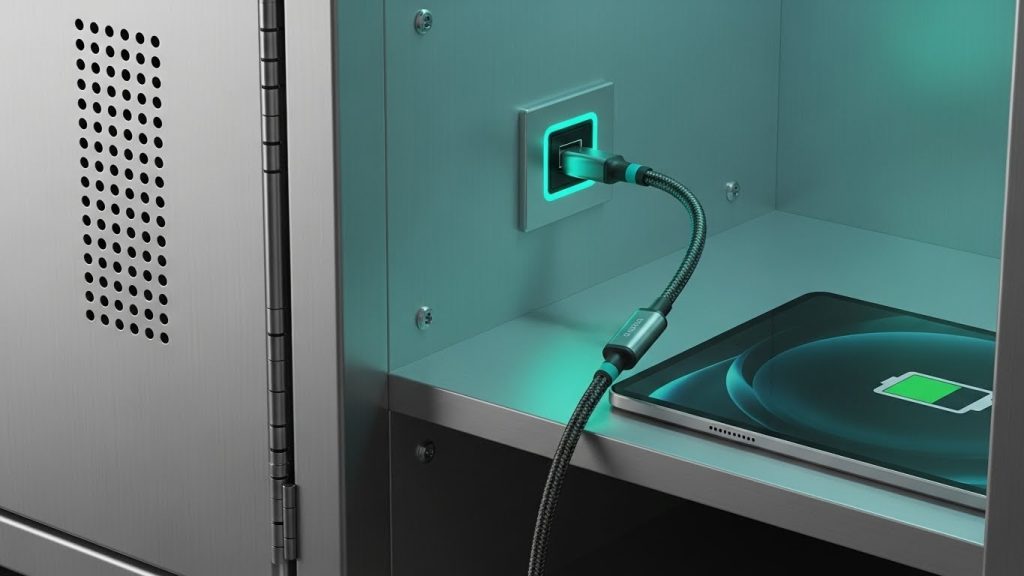
Fitting the device inside the locker is only half the battle; the other half is ensuring it can safely charge. In 2026, the standard for device power is USB-C Power Delivery (PD). While a smartphone can trickle-charge on a 5W or 10W port, a tablet requires significantly more energy—typically 30W to 45W—to charge at a reasonable speed.
If you install a locker with legacy USB-A ports, a tablet may take 12+ hours to reach a full charge, or it might not charge at all while the screen is active. Ensure your locker's internal power strip or PCB (Printed Circuit Board) supports high-wattage output. Additionally, remember that the charging cable connector adds roughly 1 to 1.5 inches to the width of the device when plugged in. If the locker is too narrow, the pressure on the charging port can cause permanent hardware damage.
Heat & Safety: Storing Larger Lithium Batteries
Tablets contain much larger lithium-ion batteries than smartphones. When these batteries charge, they generate heat. In a confined, unventilated steel box, this heat can build up quickly.
To ensure safety, look for lockers with integrated ventilation slots or "perforated" doors. Steel is an excellent heat conductor, which helps dissipate warmth, but if the locker is in a high-temperature environment, the internal temperature can exceed safe operating limits for the device. Overheating can lead to "thermal throttling," where the device slows down to cool itself, or in extreme cases, battery swelling.
You should also consider whether the locker's construction impacts the device's functionality. For example, some high-security facilities need to know if phone lockers block cell signal to prevent unauthorized communication while the device is "resting" and charging.
Use Cases: Schools, Offices, and High-Security Sites
In 2026, the "Phone-Only" policy is disappearing. Schools are now 1:1 with tablets, and corporate offices use tablets for hot-desking and inventory management.
- Schools: Need "Hybrid" units where the bottom rows are larger for tablets (iPads/Chromebooks) and the top rows are smaller for student phones.
- Hospitals: Require antimicrobial coatings and specific sizing for medical tablets used by nursing staff during shift changes.
- Military/Government: Often require lockers that fit tablets but have zero wireless transparency to meet SCIF (Sensitive Compartmented Information Facility) standards.
FAQ
No, a standard phone locker is too narrow for a 10-inch tablet. You will need a dedicated tablet locker or a hybrid unit with wider compartments to accommodate the device and its protective case.
Yes, tablets generally require higher wattage (30W+) than phones. Ensure your lockers are equipped with USB-C Power Delivery (PD) ports and that the facility's electrical circuit can handle the cumulative load of multiple tablets charging simultaneously.
Yes, provided you choose a locker with sufficient "clearance." Always measure the device with the case on and add at least one inch to all dimensions to ensure the user can insert and remove the device without snagging.
While rare, lithium batteries can overheat if they are charging in an unventilated space. High-quality lockers use perforated steel doors and heat-dissipating materials to keep internal temperatures within safe limits (needs verification of specific temperature ratings)
Most e-readers like the Kindle Paperwhite will fit in a standard cell phone locker because they are narrower than traditional tablets. However, check the depth if the Kindle has a thick "book-style" cover.
Yes, the security level is identical, typically featuring 1.0mm to 1.2mm galvanized steel and high-security digital or key locks. The only difference is the physical size of the compartment.
Conclusion
Choosing the right locker in 2026 means looking ahead at the devices your users actually carry. While standard cell phone lockers are excellent for smartphones, a modern facility benefits greatly from hybrid units that accommodate the larger footprint and higher power demands of tablets.
