
Mesh Lockers for Warehouse: The Complete Buyer's Guide (2026)
mesh lockers for warehouse facilities are one of those purchases that seems simple — until you're stuck with the wrong tier count, the wrong mesh size, or a layout that blocks your fire suppression system. This guide covers everything: types, specs, application scenarios, and exactly how to choose the right unit for your facility before placing a single order.
Whether you manage a logistics hub, a manufacturing plant floor, or a large distribution center, the information below will help you buy with confidence.
Why Mesh Lockers Are Built for Warehouse Environments
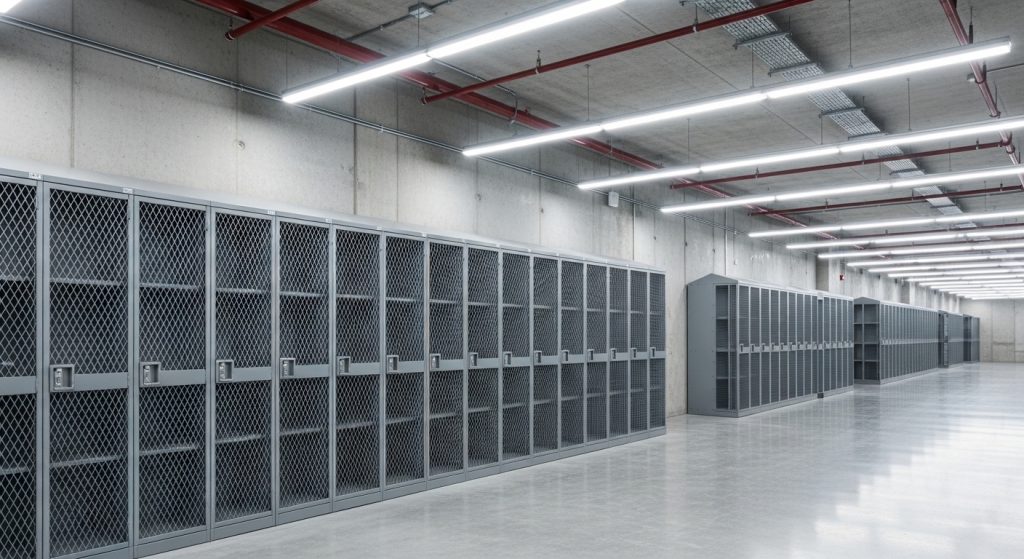
Traditional solid lockers work fine in schools and gyms. However, warehouses demand a different standard. Mesh lockers for warehouse environments are purpose-built for the realities of industrial facilities — high dust, humidity fluctuations, shift-rotation access, strict security requirements, and fire suppression compliance.
The open wire mesh structure delivers three things that solid steel simply cannot.
First, it allows fire suppression sprinklers to penetrate fully through the locker body. This is critical for NFPA compliance in most commercial warehouse and distribution facilities — a factor that solid lockers fail. Second, the mesh design gives supervisors and security staff instant visual access to stored contents without opening a single door. During shift audits or compliance checks, this saves significant time. Third, constant airflow through the mesh prevents moisture from forming on tools, PPE, and stored equipment.
Furthermore, the modular steel-frame build of industrial warehouse equipment mesh lockers means you can add, relocate, or reconfigure the entire setup as your facility layout evolves. That flexibility is genuinely valuable in a high-growth warehouse environment.
Types of Mesh Lockers for Warehouse Use
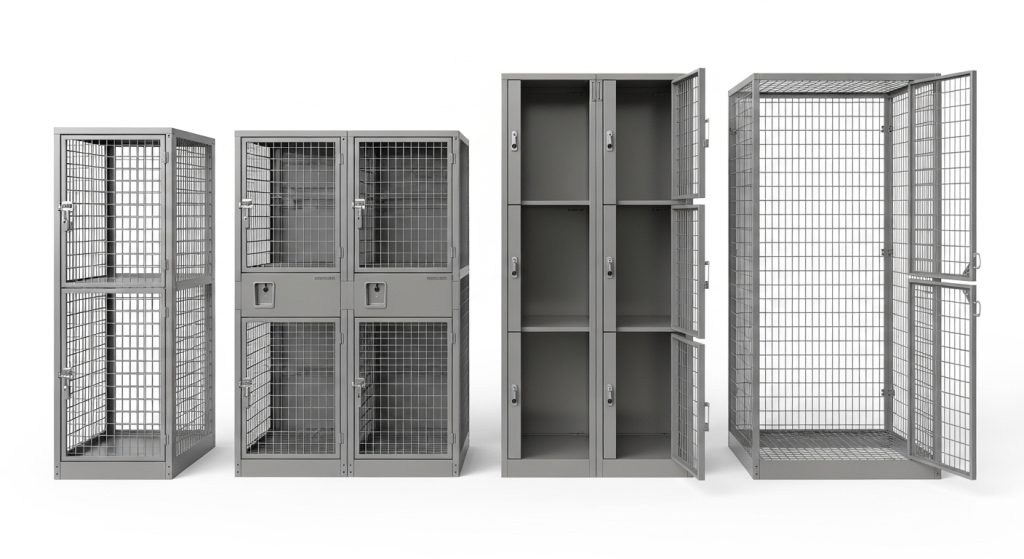
Not all mesh lockers for warehouse projects are the same. In fact, tier count, door configuration, and mesh aperture create very different practical outcomes. Here is a clear breakdown of each type and where it performs best.
Single-Tier Mesh Lockers
Single-tier units run full height — typically 1800mm to 2300mm — with one large compartment per column. They are the right choice when workers need to store full-length clothing, bulky PPE such as hard hats and reflective vests, or oversized equipment. Distribution hubs and automotive parts warehouses tend to use these most heavily.
Double-Tier Mesh Lockers
Double-tier lockers divide the same vertical footprint into two stacked compartments. Therefore, you effectively double your storage capacity without increasing your floor footprint. These work particularly well in factories with large workforces where floor space is tight.
Triple-Tier Mesh Lockers
Triple-tier units are ideal for high-density personal storage — phones, wallets, small tools, and uniforms. Moreover, they are the most cost-effective option per compartment, which makes them the standard choice for large-scale warehouse deployments with 50 or more employees.
Bulk Mesh Cage Lockers
Bulk or open-bay lockers operate at a much larger scale. Instead of individual doors, these are cage-style enclosures used for tool cribs, equipment staging areas, and parts segregation by department or workstation. You can explore the full range of these configurations on the complete mesh lockers collection page, which covers everything from personal storage units to large industrial cage solutions.
How to Choose the Right Mesh Locker for Your Warehouse
Choosing mesh lockers for warehouse procurement does not have to be complicated. However, getting it wrong — ordering the wrong tier, the wrong mesh size, or an incompatible lock system — leads to costly modifications later. Follow these three steps before placing any order.
Step 1 — Calculate Tier Count Based on Your Workforce
Start with the number of employees who need storage access. As a practical rule:
- Under 30 workers: Single-tier gives each person ample compartment space
- 30–100 workers: Double-tier is the sweet spot — balances individual space with capacity
- 100+ workers: Triple-tier, or a mix of double and triple, delivers the best density
Additionally, consider shift rotation. Shared lockers between shift teams reduce the total unit count required. However, shared use demands a more robust and easy-to-reset locking system, so factor that into your lock selection (see Step 3).
Step 2 — Choose the Right Mesh Aperture
Mesh size directly determines what can and cannot be accessed or stored securely. There are two standard options:
| Mesh Size | Wire Thickness | Best For | Security Level |
|---|---|---|---|
| 50×50mm | 3.0mm | PPE, uniforms, tools, bags | Medium — deters casual access |
| 25×25mm | 3.0–4.0mm | Small parts, electronics, valuables | High — restricts hand entry |
For most standard warehouse use, 50×50mm mesh with 3.0mm wire thickness strikes the right balance between visibility, airflow, and structural strength. On the other hand, if your workers store phones, small components, or valuables, upgrading to 25×25mm is the better call.
Step 3 — Select the Right Lock System
Lock selection depends entirely on how your warehouse manages locker assignment:
- Padlock hasp: Workers supply their own padlock. Low cost, easy to manage, ideal for shared or shift-rotation units
- Digital / RFID lock: Individual PIN or card access. Best for permanent locker assignments and high-security areas
- Supervisor-keyed padlock: Key-controlled access. Suited for tool cribs or regulated storage zones
Key Technical Specifications — What the Numbers Actually Mean
When reviewing mesh lockers for warehouse spec sheets, the figures can look dense. Here is what each one tells you in plain terms.
Frame: 25×25×1.2mm steel tube — This is the industry-standard grade for general warehouse use. It handles everyday loads comfortably. For heavy industrial environments with frequent impacts, upgrade to a 30×30mm or thicker frame.
Mesh: 50×50×3.0mm — 50mm square openings with 3.0mm wire. Wire thickness is the main indicator of impact resistance. A 3.0mm wire will not bend under accidental kicks or forklift proximity contact, as thinner wire does.
Dimensions: W1830 × D915 × H2300mm is the standard warehouse configuration, but custom sizing is available for non-standard ceiling heights, narrow aisles, or specific layout constraints.
Surface Finish: Electrostatic powder coating protects against rust, chemicals, and abrasion. In cold-storage or food distribution environments, specify galvanized steel mesh plus powder coating for maximum corrosion resistance.
Load Capacity per Shelf: Standard shelves hold up to 80kg. Heavy-duty variants with 4.0mm wire and reinforced framing support up to 150kg per shelf — essential for warehouses storing dense tooling or mechanical equipment.
Where Mesh Lockers for Warehouse Environments Work Best
The applications extend well beyond general worker storage. Here is where industrial mesh lockers create the biggest operational gains, by facility type.
E-Commerce Fulfillment Centers
Fast shift turnover means workers need quick, no-hassle locker access. The mesh design also makes security sweeps fast — supervisors can visually clear entire locker rows in seconds.
Automotive Parts Warehouses
Tool cribs and component storage by workstation are standard practice here. Single-tier mesh lockers keep tools organized, visible, and immediately accessible — no more opening multiple drawers or solid doors to locate the right equipment.
Cold Storage and Food Distribution
The ventilated design prevents condensation from building on stored uniforms and personal gear. For these environments, stainless steel mesh is worth specifying to handle the aggressive moisture conditions in refrigerated zones.
Pharmaceutical and Chemical Warehouses
Lockable, fully visible storage reduces cross-contamination risk and simplifies compliance audits. Supervisors can confirm all PPE is stored correctly without physically handling each locker.
Logistics and 3PL Hubs
Dock workers and drivers need fast, secure bag and equipment storage at shift changeover points. Double-tier mesh lockers for warehouse docks maximize capacity without eating into forklift operating space.
Manufacturing Plant Floors
Department-specific PPE storage — gloves, goggles, hearing protection by workstation — reduces the time workers lose searching for gear at shift start. In addition, visible mesh helps compliance officers spot missing or improperly stored equipment at a glance.
Mesh Lockers vs. Solid Steel Lockers — Which Is Right for a Warehouse?
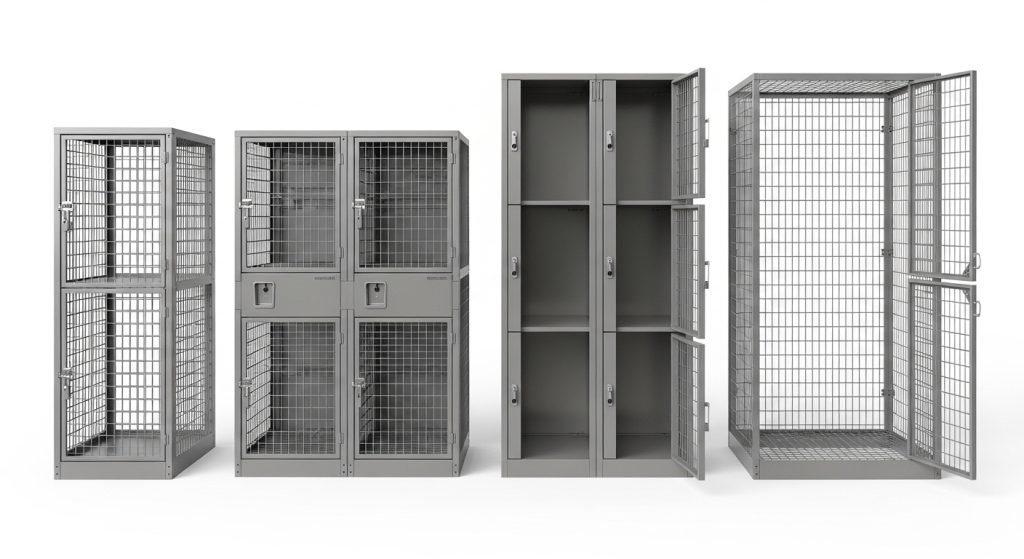
This comparison comes up in almost every warehouse procurement conversation. The honest answer depends on what you are storing. However, for the vast majority of industrial applications, mesh outperforms solid steel on the factors that matter most.
| Factor | Mesh Lockers | Solid Steel Lockers |
|---|---|---|
| Fire sprinkler compatibility | ✅ Full penetration | ❌ Blocks water flow |
| Security sweep visibility | ✅ Instant visual check | ❌ Contents completely hidden |
| Ventilation and airflow | ✅ Continuous | ❌ Poor — traps moisture |
| Personal privacy | ❌ Contents visible | ✅ Full privacy |
| Humidity resistance | ✅ No condensation buildup | ❌ Interior moisture risk |
| Best warehouse use case | PPE, tools, shift bags, equipment | Documents, personal valuables |
In practice, most warehouses use mesh as the primary locker type and add a small number of solid lockers for sensitive personal items. For larger-format storage needs beyond personal lockers, wire mesh compartment lockers and bulk cage storage units offer staging and tool-crib solutions at a larger scale.
Customization Options: What You Can Specify
One significant advantage of sourcing mesh lockers for warehouse use directly from a manufacturer is that almost nothing is locked in. Here is what you can customize before production begins:
- Dimensions: Any width, depth, and height — non-standard ceiling heights and compact aisle configurations are common and straightforward to accommodate
- Mesh aperture: 25×25mm, 50×50mm, or a fully custom size for specialist applications
- Frame gauge: Standard 25×25mm for general use, or upgraded 30×30mm for heavy industrial environments
- Surface color: Any RAL color — useful for color-coding locker banks by department, shift team, or hazard zone
- Lock type: Padlock hasp, digital, RFID, or supervisor-keyed systems
- Accessories: Internal shelves, hanging hooks, label holders, adjustable leveling feet, or caster wheels for mobile locker setups
- OEM and branding: Custom nameplates or branded panels for facility management companies and enterprise clients
GoodLockers provides CAD drawings and 3D layout simulations before manufacturing begins, so you can verify the configuration fits your space before a single unit is produced. Factory samples are also available for quality verification ahead of bulk orders.
Frequently Asked Questions About Mesh Lockers for Warehouse Use
Are mesh lockers for warehouse facilities compatible with fire suppression systems?
Yes. The open wire mesh construction allows water from overhead sprinkler systems to penetrate the locker body freely. This is why mesh lockers are preferred for NFPA-compliant warehouse facilities. Solid steel lockers, by contrast, can obstruct sprinkler coverage and may not meet fire suppression code in certain facility configurations.
What is the lead time for custom warehouse mesh lockers?
Standard stock units typically ship within 7–10 business days. Custom orders — non-standard sizes, specific RAL colors, or OEM branding — generally take 3–4 weeks from order confirmation, depending on volume and specification complexity.
Can mesh lockers be installed on uneven warehouse floors?
Yes. Adjustable leveling feet are available as a standard accessory and are strongly recommended for facilities with minor floor elevation differences. For lockers that need to be frequently relocated, caster wheel bases are also an option.
What is the minimum order quantity (MOQ)?
MOQ is flexible for factory-direct sourcing. Sample orders of 1–5 units are accepted for quality testing before large-scale procurement. Contact the GoodLockers team to discuss volume pricing and lead time for your specific project scale.
What is the maximum load capacity per shelf?
Standard shelves with 3.0mm wire support up to 80kg per shelf. Heavy-duty configurations with 4.0mm wire and reinforced frames increase that ceiling to approximately 150kg per shelf — suitable for warehouses storing dense mechanical equipment or parts inventory.
How do I maintain industrial mesh lockers long-term?
Wipe down mesh panels with a mild detergent solution, rinse, and allow to dry fully. Inspect welds and powder-coat finish annually. Address any coating chips promptly — minor surface damage left untreated leads to rust spreading along the steel tube. In high-humidity environments such as cold storage, inspect quarterly instead.
Source Mesh Lockers for Your Warehouse the Right Way
The right mesh lockers for warehouse environments are not just storage units — they are part of how your entire facility operates. Visibility, ventilation, fire safety, worker access speed, and long-term durability all connect back to this one equipment decision.
GoodLockers has manufactured custom industrial lockers since 2007, with 18+ years of factory experience, projects delivered to over 20 countries, and a full in-house engineering team ready to support custom sizing and OEM requirements. Factory samples are available, and every custom order includes CAD drawings before production begins.
