
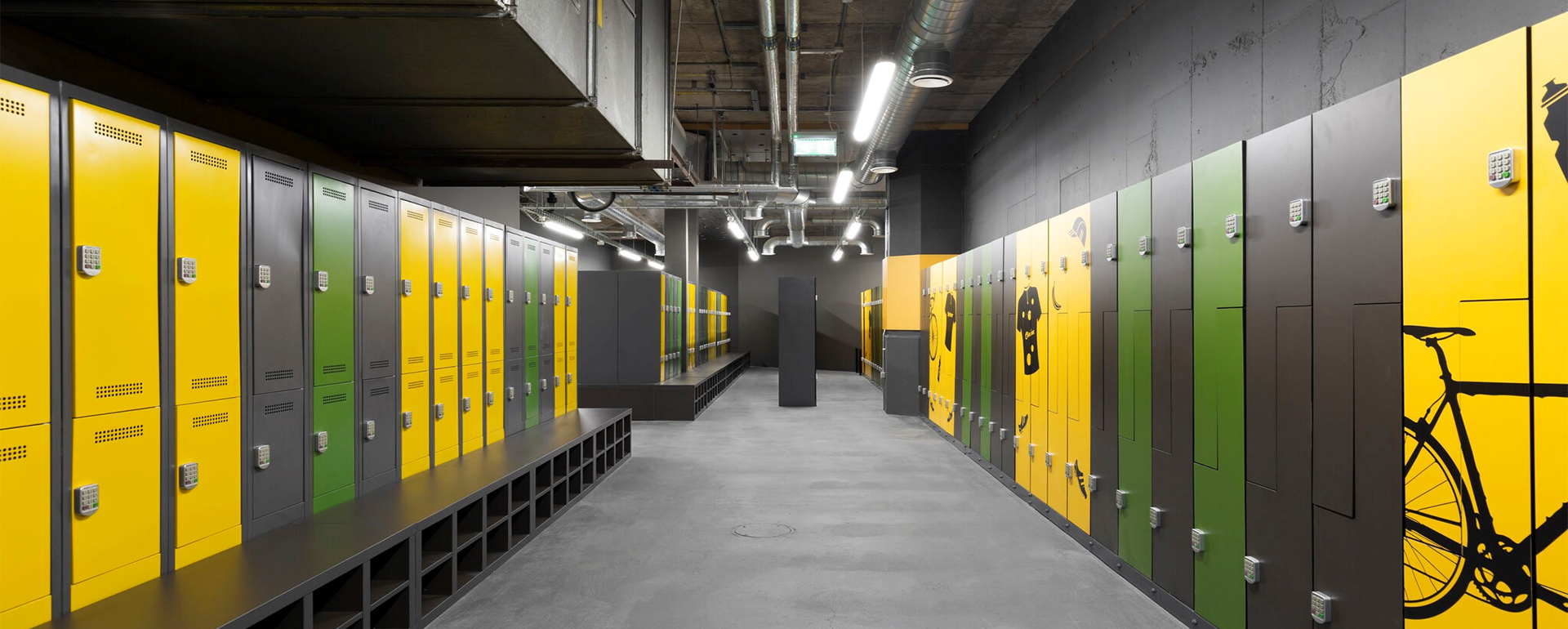
Employee Mesh Lockers: The Complete Workplace Buyer's Guide
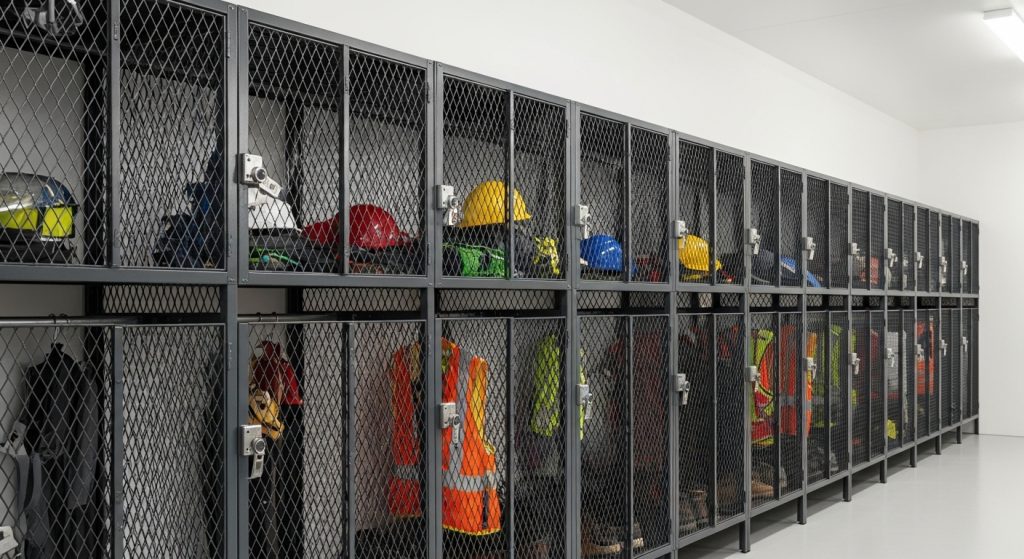
Employee mesh lockers are one of the smartest storage investments you can make for your workforce. Whether you run a warehouse, a distribution center, a hospital, or a manufacturing floor, giving your team a secure, ventilated, and clearly assigned storage space matters more than most managers expect. The right locker reduces theft, supports workplace hygiene, meets OSHA requirements, and — perhaps surprisingly — improves how employees feel about their workplace.
This guide covers everything a facilities manager, HR director, or operations lead needs before placing an order. From wire gauge and tier configurations to locking options, compliance requirements, and bulk sizing calculations — it's all here.
Why Employee Mesh Lockers Outperform Solid Lockers in Most Workplaces
Not every locker is built for the same environment. Solid steel lockers have their uses, but in high-traffic, industrial, or safety-critical facilities, employee mesh lockers consistently perform better across several dimensions.
Visibility deters theft. Open wire panels let supervisors visually confirm contents without unlocking a single door. In warehouses, retail back rooms, and factory changing areas, this eliminates the need for constant manual checks and significantly reduces opportunistic theft.
Ventilation keeps stored items clean. Work uniforms, PPE, damp gym wear, and boots all need airflow to dry properly. Without it, moisture builds up inside sealed lockers, leading to mold, mildew, and odors nobody wants to deal with. Mesh construction circulates air naturally, so items stay fresher between shifts.
Fire suppression systems stay effective. This is one of the most overlooked practical advantages. Mesh panels allow sprinkler water to pass through freely during a fire event. Solid steel lockers can block overhead sprinkler coverage in commercial facilities, creating real issues under NFPA fire codes. Furthermore, this makes mesh the safer choice from a compliance standpoint in any building with active fire suppression.
Steel mesh handles daily punishment. Employees open and close lockers multiple times a day — door hinges, lock points, and mesh panels take the brunt of that. Quality steel mesh frames resist warping, sticking, and impact damage far better than cheaper alternatives.
Moreover, employee mesh lockers are modular by design. You can add units as your workforce grows, which means no costly full replacements when headcount expands.
Types of Employee Mesh Lockers: Which Configuration Fits Your Facility?
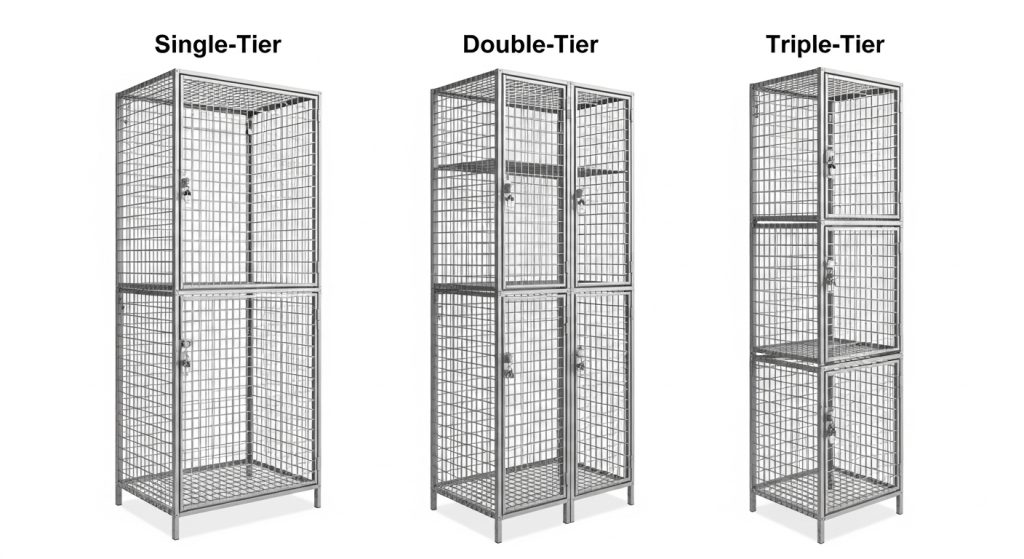
Matching your locker configuration to your floor space and workforce size is the most important decision you will make before purchasing. Here are the main options:
Single-Tier Employee Mesh Lockers
Single-tier lockers run full height — typically around 1,800mm tall — with one large compartment per column. They are the right choice for employees who need to store long coats, full-length uniforms, backpacks, large tool kits, or bulky PPE.
Manufacturing facilities, fire stations, and warehouses commonly use single-tier setups. However, because each locker takes the full column height, this configuration uses more floor space per employee than the alternatives.
Double-Tier Employee Mesh Lockers
Double-tier units stack two compartments vertically, so two employees share one locker column. This is the most popular configuration for offices, logistics centers, and retail back areas because it doubles storage capacity per square meter.
As a result, double-tier employee mesh lockers are the default choice for high-density environments where floor space is at a premium but employees still need room for a bag, jacket, and footwear.
Triple-Tier Mesh Lockers
Triple-tier units divide one column into three smaller compartments. They work well when employees only store small personal items — phones, keys, wallets, and light jackets. Call centers, schools, and light assembly operations commonly spec this format.
The tradeoff is clear: triple-tier compartments cannot accommodate bulky items like coats, helmets, or large bags. Always match compartment size to what your employees actually carry.
Modular Multi-Bay Configurations
For larger workforces, bulk configurations combine multiple locker bays in a starter-and-add-on system. You purchase a starter unit, then attach add-on bays as your team grows. This is significantly more cost-efficient than buying large pre-assembled banks — especially for facilities that expect to scale.
For a full look at available configurations across all tiers, browse the complete mesh lockers range at GoodLockers, including industrial-grade and changing room options.
Wire Gauge Explained: What the Numbers Mean for Strength and Security
Wire gauge is a detail that surprises many first-time buyers, but it directly determines how strong, secure, and long-lasting your employee mesh lockers will be.
Lower gauge number = thicker wire. Specifically:
- 10-gauge wire (~3.4mm thick): Heavy-duty industrial grade. Designed for manufacturing floors, warehouses, and military facilities, and any environment where security is a primary concern.
- 12-gauge wire (~2.8mm thick): Standard commercial grade. The right choice for offices, gyms, schools, and retail environments with moderate daily traffic.
- 14-gauge wire (~2.0mm thick): Lightweight. Suitable only for low-traffic settings where security needs are minimal.
Beyond the mesh panels, the frame structure matters just as much. A quality employee mesh locker uses square steel tube framing — not iron angle iron — for the outer skeleton. Steel tube frames handle door hinge stress and lock-point strain far better over time, especially under daily use from a large workforce.
In short: if your employees work in industrial conditions and store tools or PPE, choose 10-gauge with a steel tube frame. For office or retail applications, 12-gauge hits the right balance between strength and cost.
Locking Mechanism Guide for Employee Mesh Lockers
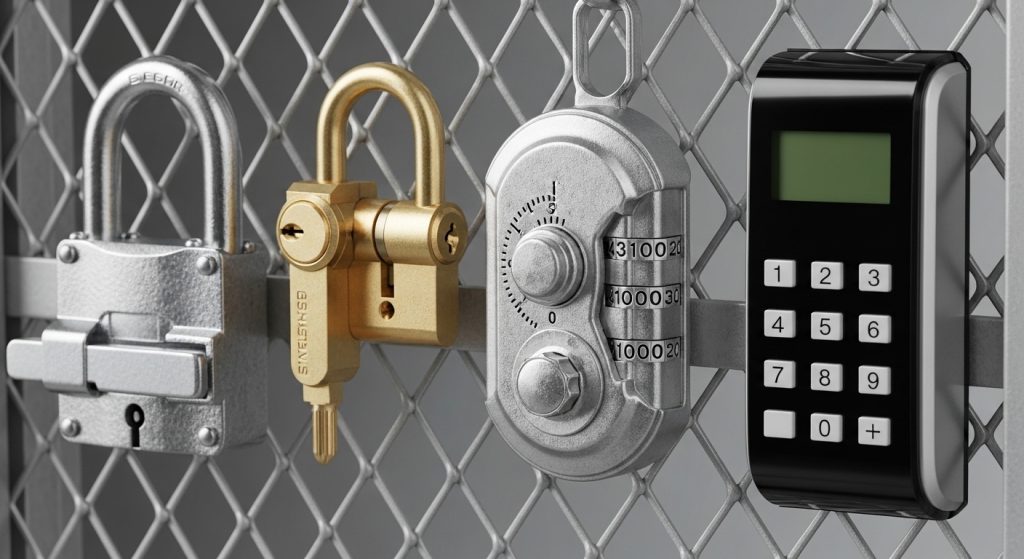
The lock type you choose affects both security and day-to-day convenience. Here is a straightforward comparison:
| Lock Type | Best For | Security Level | Employee Experience |
|---|---|---|---|
| Padlock hasp | Temporary use; employees supply their own lock | Medium | Flexible but inconsistent |
| Keyed lock | Permanently assigned lockers | High | Simple and professional |
| Combination lock | No-key environments; shared-use facilities | Medium-High | No lost-key issues |
| Electronic/smart lock | High-security or audit-trail environments | Highest | Keyless; premium feel |
For most workplaces, a keyed lock with a master key system is the most practical setup. It gives each employee ownership of their locker while letting facilities managers access any unit for cleaning or security checks.
For high-turnover environments — warehouses, distribution centers, or seasonal facilities — combination locks are the smarter call. They eliminate the hassle of collecting and reissuing keys every time an employee leaves.
Electronic locks are worth considering for healthcare facilities, data centers, or anywhere that requires an access log for compliance or security auditing.
Which Industries Use Employee Mesh Lockers — and Why It Matters
Employee mesh lockers are not a one-size-fits-all product. The same locker configuration serves very different operational needs across different sectors.
Manufacturing and Warehouse Environments
In manufacturing, mesh lockers function as PPE storage checkpoints. When lockers are transparent, supervisors can confirm at a glance that helmets, goggles, and high-vis vests are properly stored — not abandoned on the production floor. This directly reinforces daily safety compliance without any extra management effort.
Additionally, the ventilated mesh design handles damp work gear, steel-toed boots, and gloves without trapping moisture. For particularly wet or humid environments, stainless steel mesh lockers are the most durable long-term choice.
Healthcare and Hospital Staff
Healthcare workers need storage that is hygienic and fast to clean. Open mesh panels wipe down in seconds, and the construction prevents bacterial buildup behind sealed seams. Stainless steel mesh lockers are the standard recommendation for clinical environments — they withstand hospital-grade disinfectants without surface degradation.
Distribution Centers and Retail
High employee turnover in distribution and retail creates a recurring operational problem: locker reassignment. Modular employee mesh lockers solve this cleanly. Add-on units reconfigure in minutes, assignments change easily, and no existing infrastructure needs replacing. That scalability is a genuine advantage in fast-moving environments.
Gyms, Sports Facilities, and Recreation Centers
Damp towels, sports equipment, and wet footwear make ventilation non-negotiable in gym locker rooms. Mesh construction handles wet items better than any solid-door alternative. For facilities in coastal or humid climates, powder-coated galvanized mesh resists rust even when humidity is consistently high. GoodLockers supplies mesh lockers for California-based facilities and gyms where coastal conditions demand extra corrosion protection.
OSHA, Division 10, and Fire Code Compliance: What You Need to Know
Buying employee mesh lockers for a commercial facility carries real compliance implications. Here is what to check before you specify:
OSHA 1910.141 — Personal Storage: OSHA requires employers to provide suitable, separate storage for employees' personal belongings. Lockable employee mesh lockers directly satisfy this requirement. Furthermore, lockers must be separate from any area used for food storage or preparation.
Division 10, Section 10 51 43 — Architectural Specification: Architects and procurement teams working on new commercial builds or fit-outs specify lockers under this standard. If you are working with a contractor or architect, ask specifically whether your supplier can provide locker specs in this format.
NFPA Fire Suppression Compatibility: Mesh panels allow sprinkler water to flow through without obstruction. This is a direct compliance advantage over solid steel lockers in any building governed by NFPA fire suppression requirements.
ADA Accessibility: For ADA-compliant installations, locker handles and locks must be reachable between 15 and 48 inches from the finished floor. Single-tier lockers with locks at standard height typically meet this requirement. Triple-tier top compartments often do not — so plan your layout accordingly.
How to Calculate How Many Lockers Your Workforce Needs
Most facilities managers either underestimate or overestimate their locker count at first. Here is a practical method:
- One-to-one allocation: Each employee gets a permanently assigned locker. Simply count your total workforce headcount.
- Shift-sharing allocation: If you run two shifts, adjacent teams can share lockers with a clear handoff system. In this case, divide total headcount by 1.5.
- Add a 10–15% buffer for new hires, seasonal staff, contractors, and regular visitors.
Then consider storage volume. If employees store full uniforms, bulky PPE, or large tools, single-tier configurations are necessary regardless of the floor space cost. If employees only store a bag, jacket, and personal items, double-tier employee mesh lockers provide the same usable storage at half the floor footprint.
For specific dimension data and configuration guidance, the personal effect mesh locker and changing room mesh locker products on our product pages show exact dimensions for the most common workplace setups.
Employee Privacy and Visibility: Addressing the Real Concern
Mesh lockers offer full visibility — which is a security advantage. However, some employees feel uncomfortable storing personal medical items, sensitive documents, or high-value belongings in a fully transparent compartment. This is a reasonable concern and worth addressing directly rather than dismissing.
There are practical solutions that preserve both security and employee comfort:
- Solid back panels added to an otherwise mesh locker provide partial visual privacy without eliminating airflow from the sides and front.
- Interior lockable boxes within a mesh compartment create a secure space-within-a-space for high-value items.
- Numbered or named door panels give employees a sense of personal ownership — which consistently reduces resistance to open-design storage in practice.
Above all, communicate the mesh policy clearly during onboarding. When employees understand that visibility is a security feature that protects their belongings — not a surveillance mechanism — adoption is far smoother.
How to Maintain Employee Mesh Lockers: A Simple Long-Term Routine
Steel mesh lockers are low-maintenance by design. Nevertheless, a consistent routine extends their service life significantly.
- Monthly: Check hinges, lock cylinders, and door alignment. Catching minor wear early prevents it from becoming a structural issue.
- Quarterly: Wipe all mesh panels with mild detergent and warm water. For stainless steel units, use a non-abrasive cleaner applied along the grain direction.
- Every 6 months: Lubricate lock cylinders with a dry lubricant spray. Avoid WD-40 — it attracts dust and gradually degrades lock mechanisms.
- Annually: Inspect the powder coat finish for chips or scratches. Touch up any exposed bare metal immediately to prevent rust, particularly in coastal or humid environments.
With this routine in place, a quality set of employee mesh lockers will perform reliably for 10–15 years in a typical workplace. That makes the upfront investment considerably more economical than replacing cheaper alternatives every three to five years.
Frequently Asked Questions About Employee Mesh Lockers
What is the difference between employee mesh lockers and solid steel lockers?
Mesh lockers use open wire panels instead of solid sheet metal. This provides natural ventilation, visibility into stored contents, and compatibility with fire suppression systems. Solid lockers offer more visual privacy but trap moisture and can obstruct overhead sprinklers. For most workplace environments, mesh is the stronger practical choice.
What wire gauge is best for industrial employee mesh lockers?
Choose 10-gauge wire (approximately 3.4mm thick) for industrial and warehouse settings. This handles heavy daily use, resists impact damage, and provides a stronger security barrier. For offices and lighter commercial environments, 12-gauge wire offers the right strength-to-cost balance without over-engineering.
Can employees use their own padlocks on mesh lockers?
Yes — most employee mesh lockers include a padlock hasp as standard. However, many facilities choose to supply uniform keyed or combination locks for a cleaner look and simpler management. A master-key system is especially useful across a large workforce where facilities managers need occasional access.
Are employee mesh lockers OSHA-compliant?
Yes. Lockable employee mesh lockers satisfy OSHA 1910.141 requirements for personal storage in the workplace. Their open mesh construction also makes them compatible with NFPA fire suppression guidelines. When planning your locker layout, confirm that handle and lock heights meet ADA reach-range requirements for accessible installations.
Can I get employee mesh lockers in custom colors or branded finishes?
Absolutely. GoodLockers offers powder coat color customization across a wide range of RAL color codes. Color-coding locker banks by department, team, or shift is a practical way to reduce confusion in large facilities — and it creates a more professional, organized storage environment.
Ready to specify your project? Browse the full GoodLockers mesh locker range or contact us directly for a bulk quote tailored to your workforce size, industry, and facility dimensions.
