
Mesh Locker Sizes and Dimensions: Buyer’s Guide
Understanding mesh locker sizes and dimensions is the first step toward creating a functional and organized facility. Choosing the wrong size leads to cramped hallways or wasted vertical space. In my fifteen years of designing locker rooms, I have seen many managers overlook the small details.
They forget about door swing clearance or the height of a sloping top. This guide breaks down every measurement you need to know. We will explore standard heights, depths, and widths.
We will also look at how multi-tier configurations impact your storage capacity. Whether you are outfitting a gym or a high-security warehouse, this technical data ensures a perfect fit.
What are the standard mesh locker sizes and dimensions?
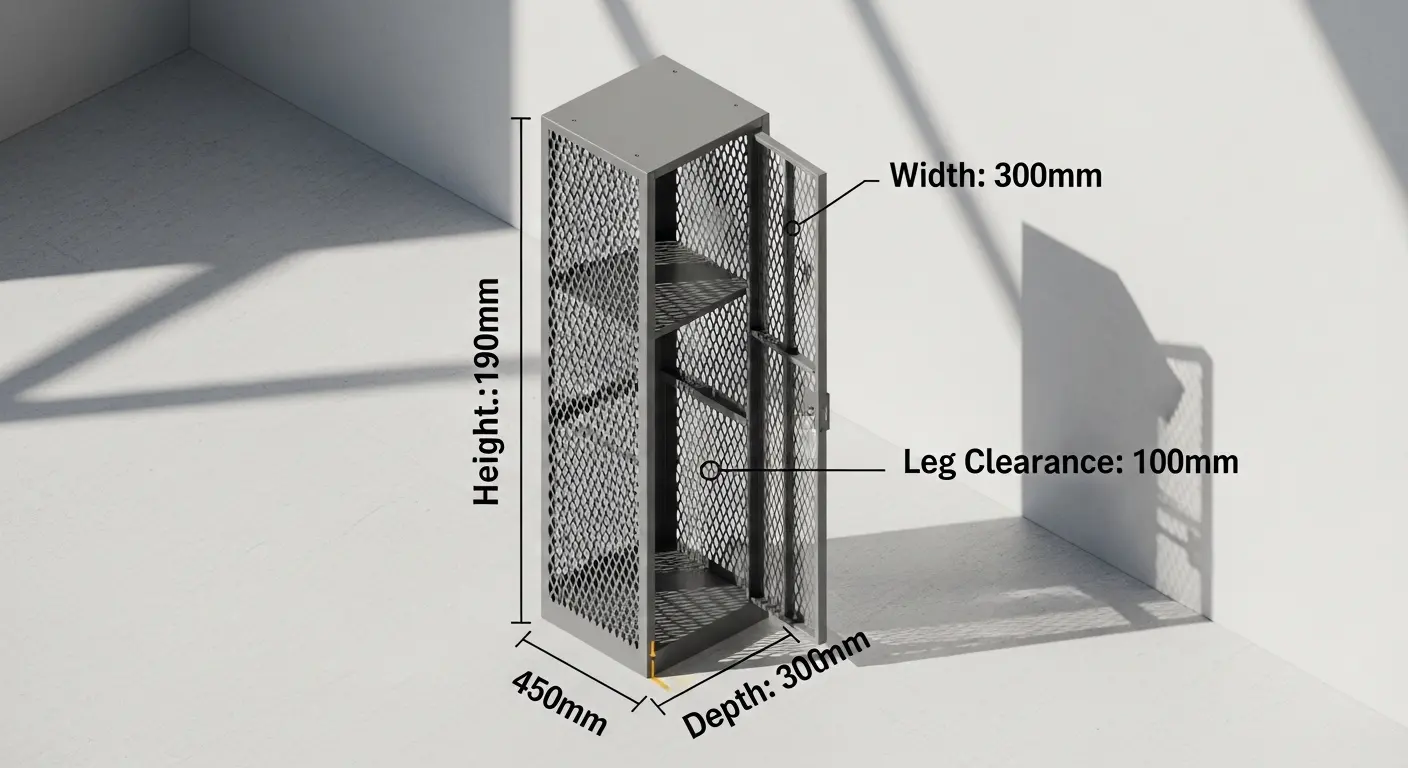
Standard mesh locker sizes typically range from 1370mm to 1980mm in height. Widths and depths usually vary between 305mm and 457mm. These dimensions provide flexibility for various environments. They ensure that users have enough space for coats, bags, or specialized industrial equipment while maintaining a compact floor footprint.
When you look at the market for mesh lockers, you will find that "standard" is a broad term. Most manufacturers stick to a 1980mm height for full-height units. This height includes the 150mm legs that keep the unit off the floor. The width and depth are the variables that change based on your specific needs.
If you are tight on space, a 305mm x 305mm unit is the classic "slim" choice. However, if your team wears heavy parkas or carries large equipment, a 457mm depth is non-negotiable. I once saw a construction firm order 305mm deep units for their site. The workers couldn't fit their hard hats and tool belts inside. They had to return the entire order. Always measure the largest item your staff carries before you commit to a size.
| Dimension Type | Standard Range (mm) | Common Industrial Choice |
| Height | 1370 - 1980 | 1980mm |
| Width | 305 - 457 | 305mm |
| Depth | 305 - 457 | 457mm |
| Mesh Aperture | 25x25 or 50x50 | 25x25mm |
How do you choose the right mesh locker size for your space?
Choosing the right mesh locker size requires measuring your available floor area and ceiling height. Consider the items being stored, such as bulky jackets or small electronics. Always account for 150mm of clearance if using a sloping top. Proper planning prevents overcrowded corridors and ensures ergonomic access for all users.
To get the most out of your room, you must think in three dimensions. First, look at the floor. You need to leave at least 900mm to 1200mm of "aisle space" in front of the lockers. This allows the doors to swing open fully without hitting anyone. Second, look at the height. If your ceilings are low, you might need a "topless" design. Using a topless wire partition mesh locker can be a smart move in basements with exposed pipes.
Tip: Use painter's tape to mark the footprint of the lockers on your floor. Walk through the space to see if the flow feels natural before you buy.
In my experience, the biggest mistake is ignoring the "stacking" potential. If you have many users but little floor space, go vertical. A 3-door or 6-door tier uses the same footprint as a 1-door unit. However, it serves six times the people. This is the secret to high-density facility management.
What are the dimensions for single-tier vs. multi-tier mesh lockers?
Single-tier mesh lockers usually offer a full 1830mm or 1980mm of vertical storage. Multi-tier units, such as 2-tier or 6-tier systems, divide that total height into smaller equal compartments. For example, a 2-tier unit provides two compartments of approximately 915mm each. This allows you to serve more people in the same footprint.
Single-tier units are the "gold standard" for changing room mesh locker setups. They include a top shelf and coat hooks. This makes them perfect for full-length suits or long winter coats.
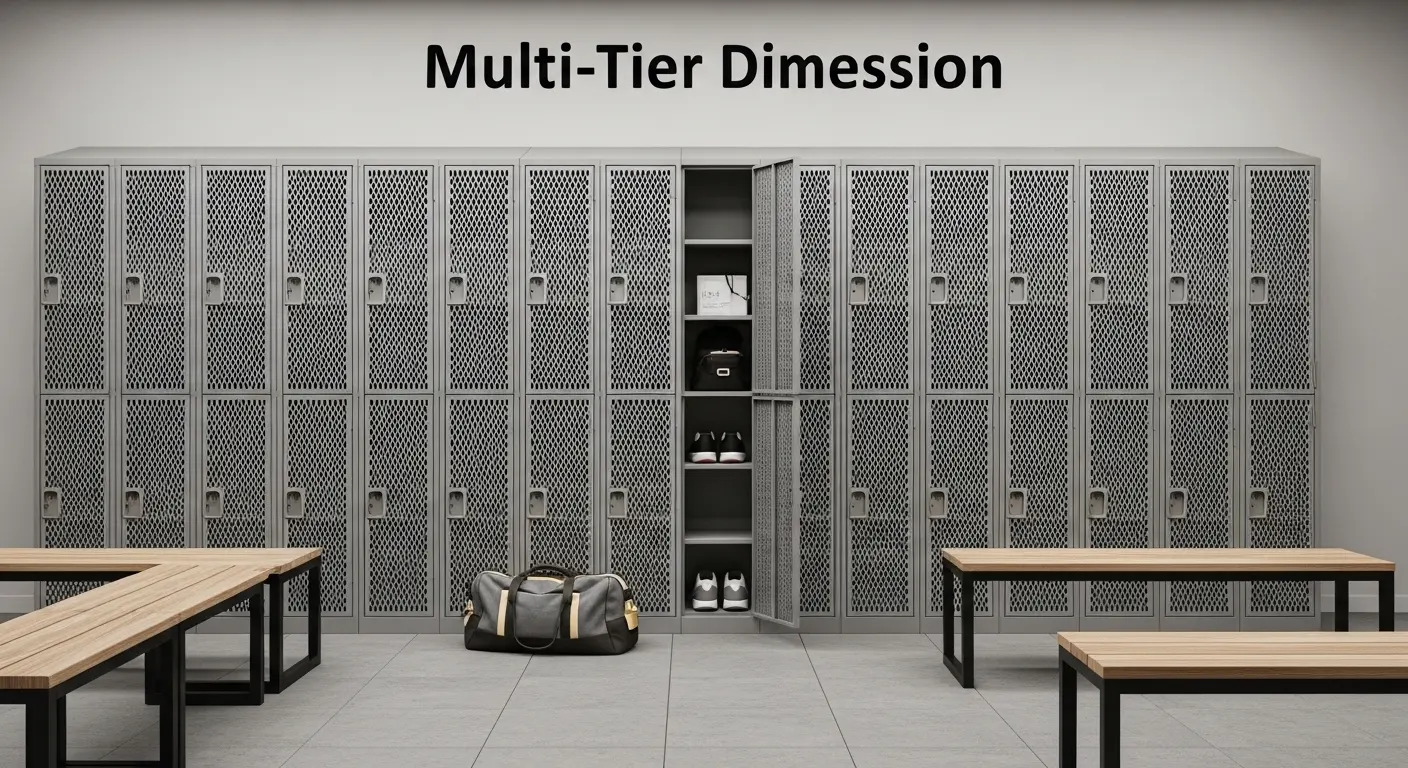
Multi-tier units are about efficiency. Here is how the dimensions typically break down for a 1980mm high unit:
- 2-Door: Each compartment is roughly 915mm high.
- 3-Door: Each compartment is roughly 610mm high.
- 6-Door: Each compartment is roughly 305mm high.
These smaller tiers are perfect for bags, shoes, or "personal effects." If your staff only needs to store a wallet, phone, and lunch, a 6-tier personal effect mesh locker is the most cost-effective solution. You save money and floor space simultaneously.
Why do wire mesh compartment sizes matter for security?
Wire mesh compartment sizes matter because they dictate the level of visibility and the type of items that can be stored securely. A 25mm x 25mm mesh prevents small items from being pulled through the holes. Larger apertures like 50mm x 50mm offer better airflow but less protection for small valuables. Choosing the right aperture ensures security.
Security is about balance. In a wire mesh compartment lockers system, the aperture size is just as important as the external dimensions. If you are storing small tools or expensive electronics, you want the tighter 25mm mesh. This makes it impossible for someone to hook an item through the mesh with a coat hanger.
I once worked with a retail backroom that used 50mm mesh for their electronics storage. They found that small earbud boxes were disappearing through the wire. We swapped them for the 25mm version, and the shrinkage stopped immediately. Visibility is your friend, but the mesh must be tight enough to act as a real barrier.
What are the dimensions for industrial and construction site mesh lockers?
Industrial and construction site mesh lockers typically require deeper dimensions, often 450mm to 600mm, to accommodate bulky PPE and tools. These units often feature reinforced frames and 25mm x 25mm mesh for maximum durability. Because site offices are often temporary, these dimensions are designed to fit into standard shipping containers or modular offices easily.
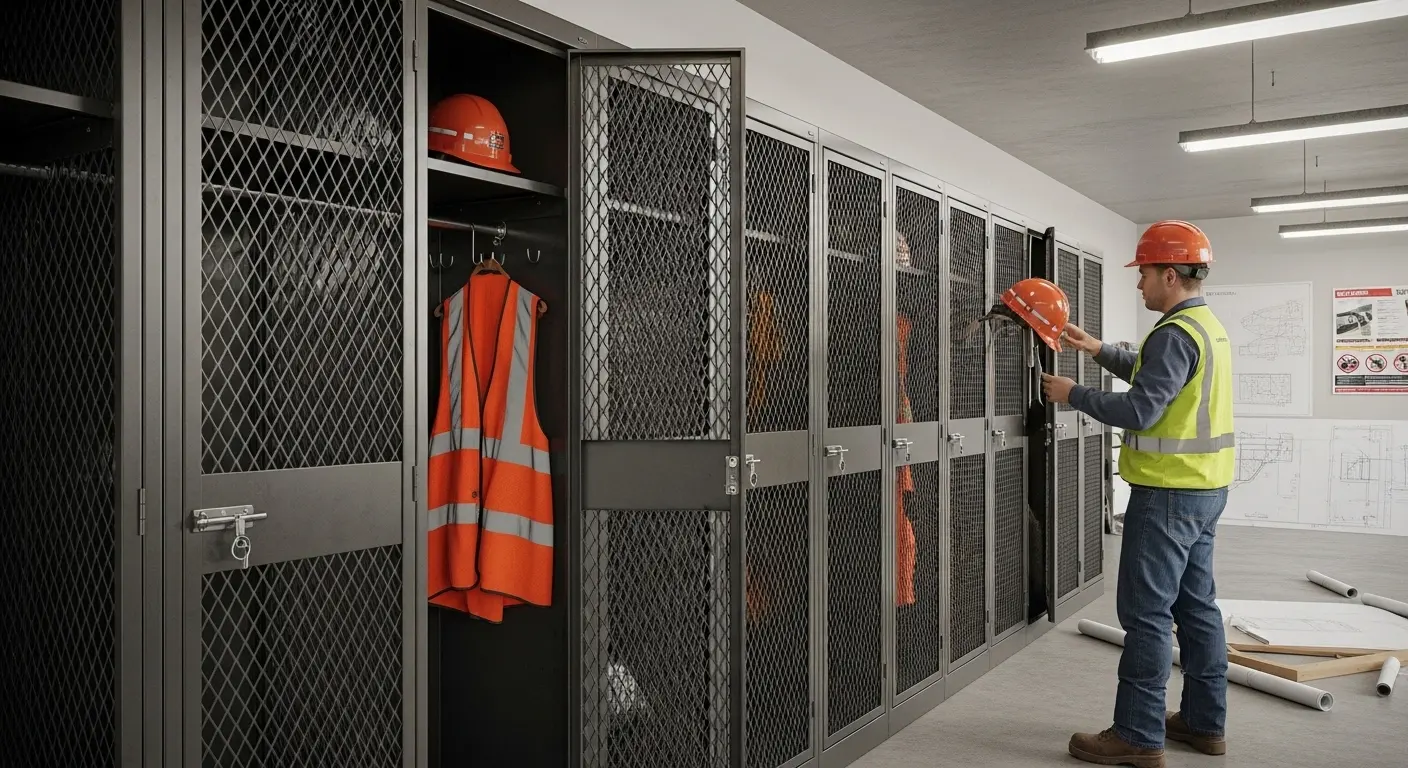
When dealing with mesh lockers for construction sites, you cannot use "office-sized" units. A worker’s hard hat, heavy boots, and high-vis jacket require volume. I recommend a minimum width of 380mm and a depth of 450mm.
| Item | Required Min. Depth (mm) | Required Min. Width (mm) |
| Hard Hat | 300 | 300 |
| Work Boots (Size 12) | 350 | 250 |
| Tool Belt | 400 | 350 |
| Heavy Winter Parka | 450 | 380 |
If you are using these on a site, consider the "sloping top" dimension. A sloping top adds about 150mm to the rear height of the locker. This is essential for preventing dust buildup and stopping people from leaving lunch containers on top of the units. It’s a small dimension that makes a massive difference in site cleanliness.
Are there specialized dimensions for tenant and bulk storage?
Specialized dimensions for tenant storage usually feature much larger footprints, often 915mm wide and 1220mm deep. These are designed for seasonal items like bikes, tires, or luggage. Bulk storage lockers can be even larger, acting more like modular cages than individual lockers. They provide high-volume storage in apartment basements or commercial warehouses.
A mesh tenant storage locker is a different beast entirely. While a staff locker is for a jacket, a tenant locker is for a lifestyle. These units often come in "walk-in" sizes. [Statistics: Apartment complexes using mesh tenant lockers report a 30% increase in tenant satisfaction regarding storage.]
- Height: Often reaches up to 2100mm or 2400mm.
- Width: Starts at 915mm and can go up to 1500mm.
- Depth: Typically 1220mm to 1522mm.
Because these units are so large, they often use a heavier gauge of wire. You aren't just protecting a wallet; you might be protecting $5,000 worth of mountain bikes. The dimensions must allow for easy entry and exit, so double doors are common on these larger units.
How does mesh thickness impact the overall external dimensions?
Mesh thickness, or wire gauge, usually adds very little to the external dimensions but significantly impacts the weight and strength. A 10-gauge wire is thicker than a 12-gauge wire. While the locker might look the same size, the heavier gauge ensures it won't dent or bow under the pressure of heavy stored items.
Don't be fooled by the "outer" dimensions. The "inner" strength is what matters. In industrial settings, a "heavy-duty" locker will have the same 305mm width as a "standard" one, but the frame will be 25mm box section steel rather than light angle iron.
Tip: If you are stacking lockers, the thickness of the frame matters. A thicker frame allows you to stack units three or four high without the bottom locker buckling.
I always recommend checking the "internal clear opening" dimensions. Sometimes, the frame of the locker takes up 20mm on each side. If you have an item that is exactly 300mm wide, it might not fit through the door of a 305mm wide locker. Always leave a "buffer" of at least 25mm for easy access.
How to measure your facility for a mesh locker installation?
Measuring your facility requires identifying the total length of the wall, the height of any obstructions, and the depth of the "walkway." You must also account for any baseboards, radiators, or electrical boxes that might push the lockers away from the wall. Always leave a 50mm "shim space" at the end of a row for final adjustments.
I have seen many installations fail because someone forgot about a radiator. They measured the wall, ordered 10 lockers, and then realized a heating unit took up the space of the last locker.
- Measure the total wall length: Subtract 100mm for "wiggle room."
- Check the ceiling height: Include lighting fixtures and sprinklers.
- Check for floor slopes: Mesh lockers have adjustable feet, but only up to 25mm.
- Mark the door swing: Ensure the lockers don't block exits when open.
If you are working in a tight basement, you might need a customized height. Many mesh locker manufacturers can trim the legs or the top frame to fit under low-hanging pipes. It is better to measure twice and order once than to try and "make it fit" on-site.
Frequently Asked Questions
What is the most common width for a staff locker?
The most common width is 305mm (12 inches). This is wide enough for a standard coat hanger and a backpack while allowing you to fit many units in a small space.
Can I get custom mesh locker sizes?
Yes. Most industrial manufacturers can create bespoke dimensions. However, custom sizes usually have a longer lead time and a higher price point than standard "off-the-shelf" units.
Do the dimensions include the legs?
Usually, yes. A 1980mm high locker typically includes 150mm legs and a 1830mm locker body. Always confirm this with your supplier, as some "flat-base" models do not have legs.
How much space does a sloping top add?
A standard sloping top adds approximately 150mm to the height of the locker at the rear. This creates a 30-degree angle that prevents items from being stored on top.
Are the dimensions the same for all mesh types?
The external dimensions are generally consistent, but the "internal clearance" can vary. A locker made with a 25mm frame will have slightly less interior space than one made with a 15mm frame.
Summary of Selecting the Best Dimensions
Choosing the right mesh locker sizes and dimensions is about matching the storage to the user’s reality. Don’t just guess; measure your equipment, your space, and your traffic flow. A full-height unit is best for changing rooms, while multi-tier compartments are the champions of space-saving. For industrial sites, prioritize depth for PPE. For residential tenants, go for walk-in bulk sizes.
By paying attention to these measurements now, you avoid the headaches of a poorly functioning facility later. Focus on the internal clearance and the external footprint. With the right dimensions, your storage system will be a silent, efficient partner in your daily operations.
