
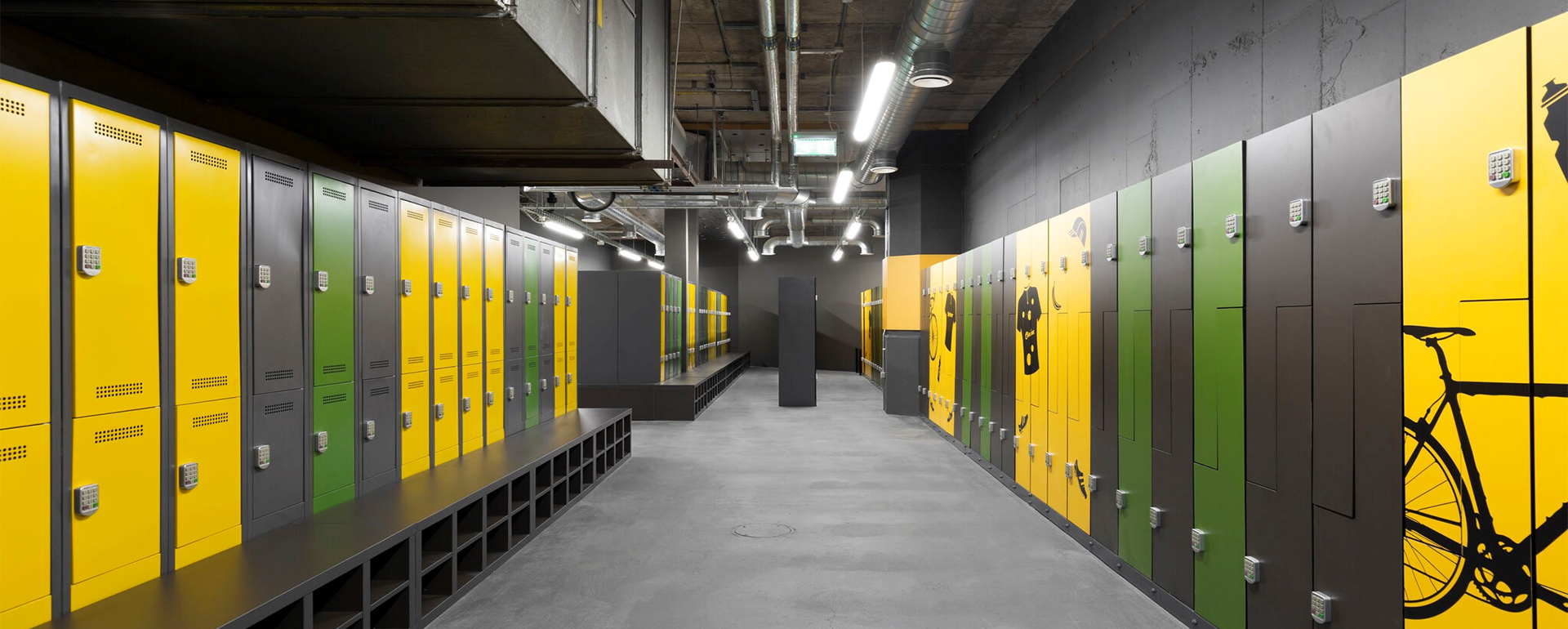
Apartment Storage Lockers: Types, Sizes & Costs Explained
Apartment storage lockers are the fastest-returning amenity investment a property manager can make. The U.S. needs 4.3 million more apartment units by 2035, according to the National Apartment Association — and as unit sizes shrink to meet that demand, off-unit storage becomes a competitive differentiator, not a bonus feature.
This guide draws on 17 years of manufacturing apartment storage lockers for residential buildings across North America, Europe, and Asia-Pacific. You won't find a generic brand list here. Instead, you'll get specification-level guidance: locker types, material comparisons, sizing formulas, fire code requirements, and a step-by-step decision framework. By the end, you'll know exactly which system fits your building — and how to move confidently toward procurement.
What Are Apartment Storage Lockers?
Apartment storage lockers — also called tenant storage lockers or bulk storage lockers — are individual, lockable enclosures installed in shared building spaces. These spaces typically include basements, parking garages, and utility corridors. Each locker is assigned to a single tenant, providing a dedicated place for seasonal items, sports gear, and oversized belongings outside their unit.
These are not self-storage units. They are property-managed building infrastructure. Therefore, they function as an amenity that generates ancillary rental income for the property owner.
Two primary configurations exist: single-tier walk-in units and double-tier stacked units. Two primary materials are used: wire mesh and solid steel. Together, these four variables — configuration, material, size, and locking mechanism — define every apartment storage locker decision.
5 Types of Apartment Storage Lockers
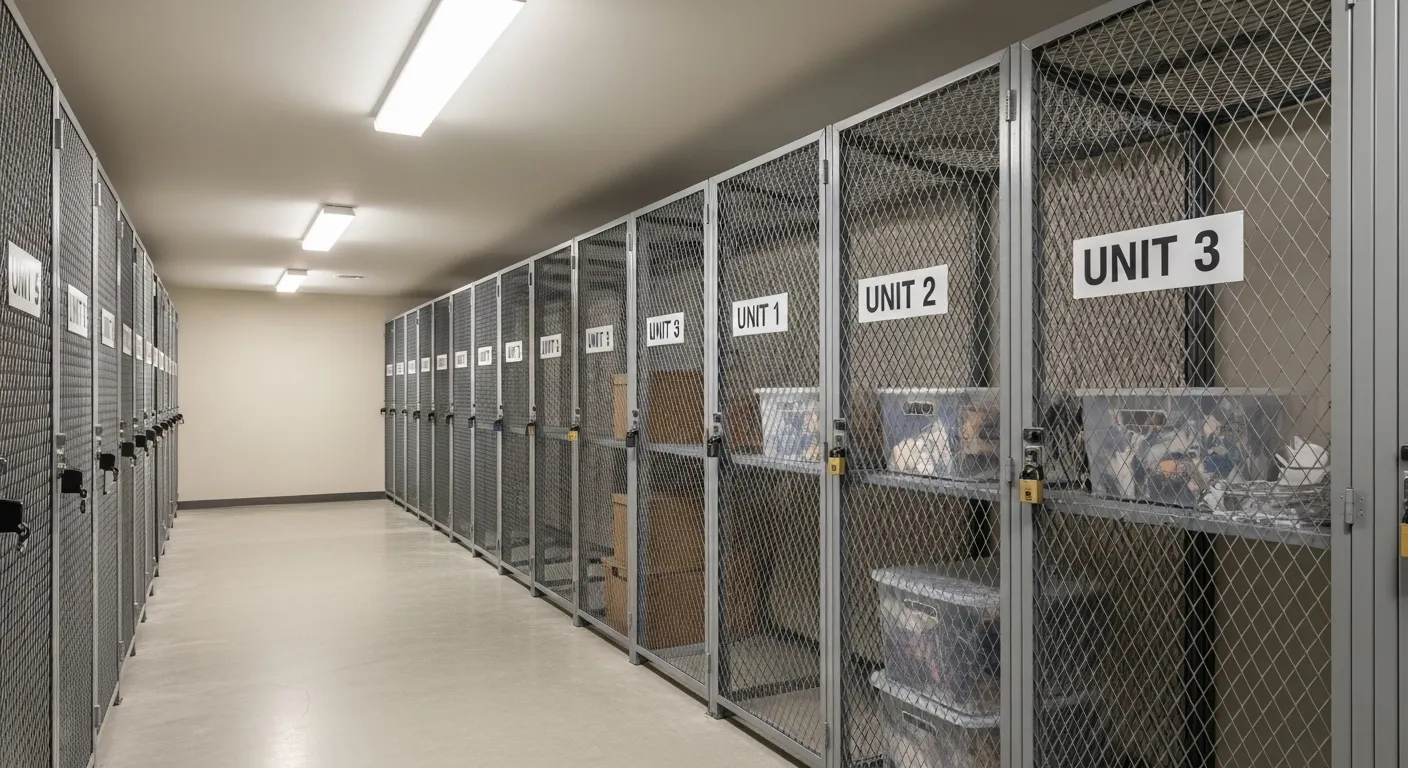
Selecting the right locker type requires matching the product to your building's layout, environment, and tenant profile. Here are the five configurations used in residential buildings today.
Wire Mesh Bulk Storage Lockers
Wire mesh lockers are the industry standard for residential storage. They use welded wire panels — typically 10-gauge steel with 2"×2" openings — to form all walls and the door. This open construction provides three critical benefits simultaneously: airflow to prevent mold, sightline visibility to deter theft, and sprinkler water pass-through to satisfy NFPA 13 fire code.
In our experience manufacturing for residential projects across 20+ countries, wire mesh accounts for approximately 80% of all apartment locker orders. It performs reliably in basements and garages where humidity and ventilation are ongoing concerns.
Explore GoodLockers' wire mesh locker configurations for residential bulk storage options.
Best for: Most multi-family residential buildings with basement or garage storage rooms.
Solid Steel Storage Lockers
Solid steel lockers offer complete visual privacy and a more finished aesthetic. They are, however, heavier, more expensive per unit, and — critically — they provide no ventilation. Additionally, they may require dedicated sprinkler heads inside each enclosure depending on local fire codes, which adds installation cost.
Best for: Luxury condos with fully climate-controlled, enclosed storage rooms.
Double-Tier Stacked Lockers
Double-tier lockers stack two units vertically on a single base frame. This configuration doubles your locker count without increasing your floor footprint. In our experience, double-tier layouts save 30–40% of floor space compared to single-tier equivalents. Consequently, they are the preferred choice for urban buildings with limited basement square footage.
Best for: Space-constrained basements; buildings that need maximum locker density per square foot.
Over-Car Storage Lockers
Over-car lockers mount above parking stalls in structured garages. They use the vertical clearance above parked vehicles — typically 7–9 feet of overhead space — to create storage without occupying floor area. This configuration requires a minimum ceiling height of approximately 14 feet.
Best for: Urban condos and high-rise buildings with structured parking but no dedicated storage room.
HPL / Phenolic Storage Lockers
High-pressure laminate (HPL) lockers — also called phenolic lockers — are waterproof, impact-resistant, and highly resistant to humidity and mold. They outperform standard metal lockers significantly in wet environments. However, their cost is higher than standard wire mesh.
Best for: Pool-adjacent buildings, coastal properties, and any installation with persistent moisture exposure.
Wire Mesh vs. Solid Steel: Which Material Is Right?
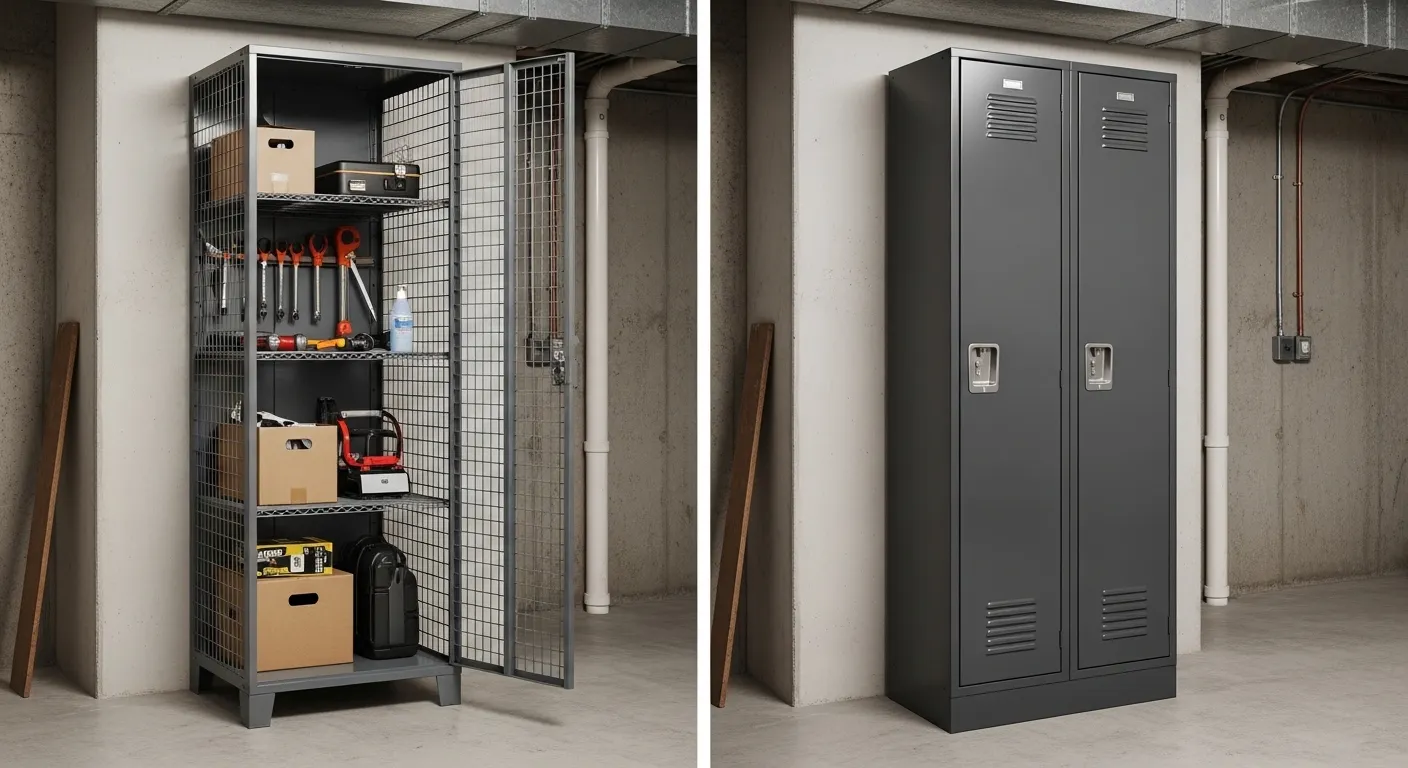
Wire mesh is the right choice for most apartment buildings. However, the final decision depends on your specific environment, budget, and aesthetic requirements.
| Feature | Wire Mesh | Solid Steel |
|---|---|---|
| Ventilation | ✅ Excellent airflow | ❌ None — moisture risk |
| Visibility | ✅ Contents visible | ❌ Full visual privacy |
| NFPA 13 Compliance | ✅ Sprinkler-compliant as-is | ⚠️ May need extra sprinkler heads |
| Aesthetics | Utilitarian / industrial | Premium / finished |
| Per-Unit Cost | Lower | Higher |
| Weight | Lighter | Heavier |
| Best Environment | Basement, parking garage | Climate-controlled room |
Build Quality: What the Gauge Number Actually Means
Not all wire mesh lockers are equal. After manufacturing thousands of locker systems for residential projects, we consistently see rust failure on units below 1.0mm galvanized steel within 2–3 years in basement environments. Therefore, always specify a minimum of 1.0mm galvanized or powder-coated steel — regardless of the supplier.
The mesh panel gauge also matters. Ten-gauge welded wire (0.135" diameter) provides the right balance of structural rigidity and visibility. Lighter gauges — 12-gauge or thinner — flex under load and are easier to compromise.
Fire Code: The Factor Most Buyers Overlook
The open panel design of wire mesh allows sprinkler water to penetrate the locker interior directly. This satisfies NFPA 13 requirements without additional hardware or modification. Solid steel lockers, by contrast, may require a separate sprinkler head inside each unit. Always confirm this requirement with your local fire marshal before making a material decision.
Standard Sizes & Configuration Guide
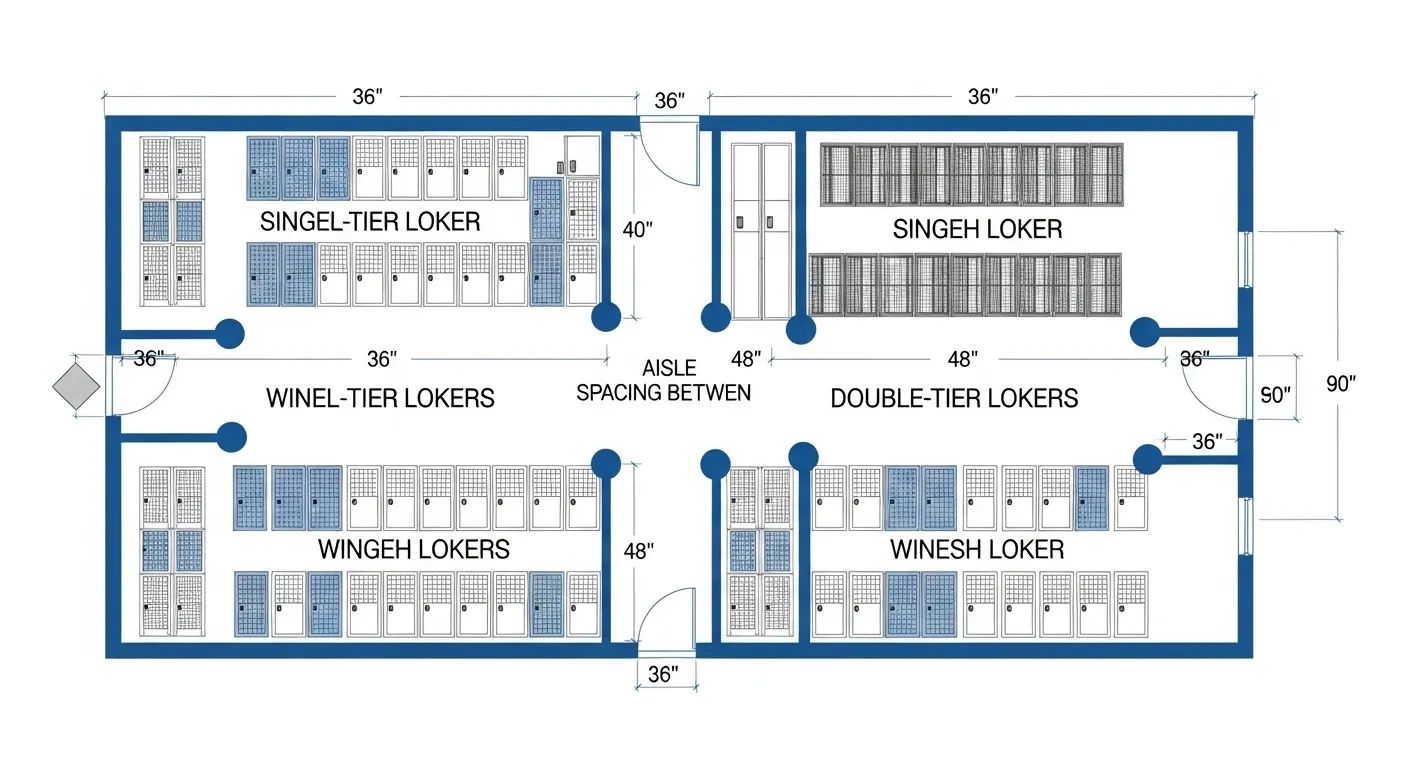
Most apartment buildings use single-tier units measuring 36"W × 48"D × 90"H or 48"W × 48"D × 90"H as their standard. These dimensions comfortably accommodate a bicycle, seasonal furniture, large moving boxes, and bulky sports equipment.
Double-tier configurations use the same floor footprint but stack two units to 90" total height — each tier typically measures 36"–48" tall.
| Configuration | Width | Depth | Height | Best Use |
|---|---|---|---|---|
| Single-tier compact | 36" | 36" | 90" | Studios and small units |
| Single-tier standard | 36" | 48" | 90" | 1–2 bedroom units |
| Single-tier large | 48" | 48" | 90" | 2–3 bedroom units |
| Double-tier standard | 36" | 36" | 90" total | High-density buildings |
| Double-tier large | 48" | 48" | 90" total | Mixed residential use |
How Many Lockers Does Your Building Need?
Use this formula to calculate your starter count:
Recommended locker count = Total residential units × 0.85
The 0.85 multiplier accounts for typical vacancy rates. For example, a 100-unit building should start with approximately 85 single-tier lockers — or 45 double-tier units when floor space is limited. For new builds, additionally plan for future expansion by choosing a modular locker system that allows bolt-on additions to existing runs.
How to Measure Your Storage Room
Before placing any order, take three measurements on-site:
- Wall-to-wall clearance — You need a minimum 36" aisle between facing locker runs to satisfy most building egress requirements.
- Ceiling height — Standard 90" lockers require at least 96" (8 ft) of clear ceiling height. Account for overhead pipes, ductwork, and structural beams.
- Structural obstacles — Columns, water shutoffs, and electrical panels may require unit cut-outs or custom dimensions. Custom fabrication handles these scenarios; standard catalog products do not.
Locking Mechanisms: Padlock, Keyed, or Electronic?
The right locking mechanism depends on your management model and your building's security tier.
| Lock Type | Security Level | Management Load | Additional Cost | Best For |
|---|---|---|---|---|
| Padlock hasp (tenant-supplied) | Medium | Minimal | $0 | Standard apartments |
| Built-in keyed lock | High | High (key tracking required) | Moderate | Mid-tier condos |
| Electronic / keypad | Highest | Low (digital logs) | $500–$2,000/unit | Luxury buildings |
The Padlock Hasp: Why It's the Industry Default
The padlock hasp locker is the most widely used locking mechanism for apartment storage applications. It requires no master key management by building staff — tenants supply their own lock. This approach reduces your administrative overhead significantly while keeping the building's maintenance responsibility minimal.
However, advise tenants to use disc locks or shrouded padlocks rather than standard open-shackle locks. A shrouded padlock exposes far less of the shackle, making it substantially more resistant to bolt cutter attacks.
Electronic Locks: When the ROI Makes Sense
Smart lock units log every entry with a timestamp, offering the highest security and the lowest ongoing management load. Nevertheless, at $500–$2,000 per unit, they require a reliable power connection at each locker. For standard apartment buildings, this cost is difficult to justify. For luxury condos charging $75+/month per locker, however, the return calculation becomes favorable.
Apartment Storage Locker Costs: What to Budget
Apartment storage lockers represent a capital investment that most property managers recover in under 12 months through monthly tenant rental fees, according to WireCrafters — one of the most cited manufacturers in the US residential locker market.
| Purchase Channel | Single-Tier (per unit) | Double-Tier (per unit) | Installation (per unit) |
|---|---|---|---|
| US distributor | $400–$815 | $650–$1,200 | $100–$500 |
| Direct-from-manufacturer | Significantly lower at 25+ units | Lower per-unit at volume | Factory shipping + local contractor |
US distributor pricing for standard wire mesh lockers currently ranges from approximately $469–$815 per unit (based on published Hallowell and WireCrafters pricing). Electronic access units add $500–$2,000 per locker on top of that base cost.
ROI Calculation for Property Managers
Here is a straightforward return-on-investment model for a 50-locker installation:
- Unit cost (US distributor, mid-range): 50 × $600 = $30,000
- Installation: 50 × $250 = $12,500
- Total investment: ~$42,500
- Monthly rental income: 50 × $40/month = $2,000/month
- Payback period: approximately 21 months
However, property managers who source directly from a custom manufacturer at bulk pricing can reduce per-unit cost by 30–40% on orders of 25+ units. At that reduction, the same 50-locker project reaches payback in 12–14 months instead.
Monthly locker rental rates typically range from $25–$75 per unit. Urban markets — New York, Los Angeles, Toronto, Sydney — trend toward the higher end of that range.
Direct-from-Manufacturer vs. US Distributor
US distributors offer faster domestic delivery and local sales support. However, they add a markup layer — typically 30–50% over manufacturer cost. For large residential projects (50+ lockers), sourcing directly from a manufacturer allows full customization of dimensions, materials, and finish. GoodLockers ships factory-direct to the USA, Canada, UK, Australia, and 17+ additional countries. Lead time for custom bulk orders is typically 25–35 business days from order confirmation.
Fire Code & Building Compliance: What You Must Verify First
Wire mesh apartment storage lockers comply with NFPA 13 — the National Fire Protection Association's sprinkler installation standard — because their open panel construction allows water pass-through without obstruction. This is the primary reason wire mesh dominates residential locker applications across North America.
Solid steel lockers, by contrast, may require a dedicated sprinkler head inside each enclosure. That requirement adds both installation cost and coordination with a fire suppression contractor.
Pre-Installation Compliance Checklist:
- ✅ Specify wire mesh construction for automatic NFPA 13 sprinkler compliance
- ✅ Confirm minimum 36" egress aisle between all facing locker runs
- ✅ Verify 96"+ clear ceiling height for standard 90" units
- ✅ Check whether local code requires a building permit for permanent locker installation
- ✅ Confirm whether modular/portable systems qualify for a permit exemption in your jurisdiction
- ✅ Request material certifications and spec sheets from your manufacturer for all code submissions
GoodLockers provides complete material certification documentation and dimensional spec sheets for all products. These documents support building permit applications and fire code submissions in most jurisdictions worldwide.
How to Choose the Right Apartment Storage Locker System
Selecting the right system comes down to seven sequential questions. Work through them in order, and the decision becomes straightforward.
Step 1 — Measure your available space. Record wall-to-wall floor dimensions, ceiling height, and all structural obstacle locations.
Step 2 — Calculate your locker count. Apply the formula: total residential units × 0.85 = recommended starter count. Round up to the nearest multiple of 5 for cleaner installation runs.
Step 3 — Choose your configuration. If ceiling height is 8 ft or more, single-tier works well. If space is limited, double-tier doubles your count on the same footprint.
Step 4 — Choose your material. For basements and parking garages, wire mesh is the correct default. For climate-controlled luxury storage rooms, solid steel or HPL is the better choice.
Step 5 — Choose your locking mechanism. Standard buildings: padlock hasp. Mid-tier condos: built-in keyed lock. Luxury buildings with higher rental rates: electronic access control.
Step 6 — Set your budget. Establish a per-unit budget based on your configuration and material choice. Then compare US distributor pricing against direct-from-manufacturer pricing for orders of 25 units or more.
Step 7 — Request a custom specification quote. Approximately 40% of our residential clients require custom sizing due to non-standard basement or garage layouts. Provide your room dimensions and unit count, and a manufacturer can supply dimensioned drawings and a factory-direct price.
Frequently Asked Questions About Apartment Storage Lockers
What size storage locker do most apartment buildings use?
Most apartment buildings install single-tier units measuring 36"W × 48"D × 90"H or 48"W × 48"D × 90"H. These dimensions accommodate a standard bicycle, seasonal furniture, moving boxes, and sports equipment comfortably. Double-tier units in a 36"W × 36"D footprint are the most common choice in space-constrained basements where floor area is limited.
Are wire mesh lockers or solid steel better for apartments?
Wire mesh is the industry standard for 80–90% of residential applications. It provides airflow to prevent mold, sightline visibility to deter theft, and compliance with NFPA 13 sprinkler codes without modification. Solid steel is a better fit for climate-controlled, luxury environments where visual privacy is a higher priority than ventilation.
How many storage lockers does an apartment building need?
A reliable starting formula is: total residential units × 0.85 = recommended locker count. A 100-unit building, therefore, should plan for approximately 85 single-tier or 45 double-tier units. Always account for your current vacancy rate and select a modular locker system that allows future expansion without replacing the existing structure.
How much does it cost to install storage lockers in an apartment building?
US distributor pricing ranges from $400–$1,200 per unit depending on configuration and material. Installation adds approximately $100–$500 per unit. Direct-from-manufacturer custom orders reduce per-unit cost significantly for orders of 25 units or more. Most property managers recover the full investment in 10–21 months through monthly locker rental fees ranging from $25–$75 per unit.
Do apartment storage lockers need to comply with fire codes?
Yes — fire code compliance is non-negotiable. Wire mesh lockers comply with NFPA 13 because their open construction allows sprinkler water to pass through freely. Solid steel units may require dedicated sprinkler heads inside each locker, adding cost and installation complexity. Always confirm the specific local requirements with your fire marshal and building code authority before finalizing your material selection.
Choosing Lockers That Work for Your Building Long-Term
Three decisions determine every successful apartment storage locker project. First, choose the right configuration — single-tier for standard ceiling heights, double-tier for space-constrained buildings. Second, choose the right material — wire mesh for basements and garages, solid steel or HPL for premium climate-controlled environments. Third, choose the right sourcing channel — US distributor for speed, direct manufacturer for customization and lower per-unit cost on larger orders.
For most residential buildings, wire mesh single-tier lockers in a 36"×48"×90" configuration represent the optimal starting point. The ROI case is strong, the compliance path is clear, and the tenant value is immediate.
GoodLockers manufactures custom apartment storage lockers for residential complexes worldwide. Request a factory-direct quote tailored to your building's exact dimensions, unit count, and material requirements.
Written by the GoodLockers Product & Manufacturing Team | 17+ years of custom locker fabrication for residential, commercial, and institutional projects across 20+ countries.
