
Bike Locker vs Vertical Bike Rack: Which Saves More Space?
The bike locker vs vertical bike rack debate is all about space, but the answer is not as simple as you think. As a facility consultant, my job is to design secure bike parking. The most common mistake I see is choosing a product that solves the wrong problem.
So, which one really saves more space?
A vertical bike rack saves more horizontal floor space by storing many bikes in a small footprint. It is a high-density solution. A bike locker is a self-contained, high-security unit for one bike. It is the most secure, but least space-efficient option per bike.
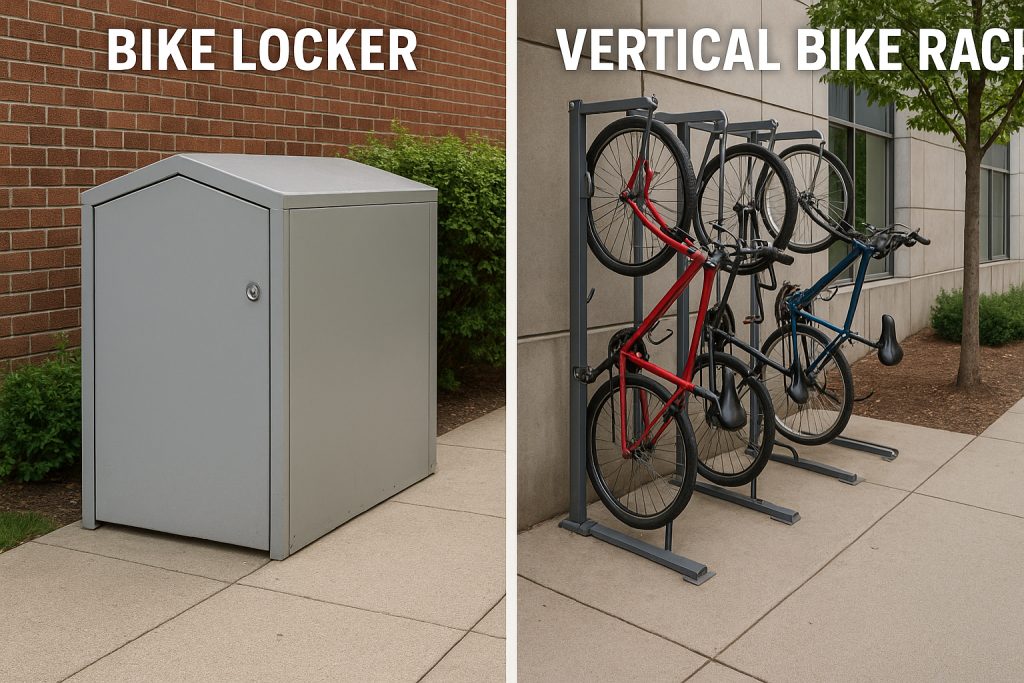
One is a filing cabinet for bikes. The other is a private safe. Your choice depends on what you are trying to protect and where. This guide will break down every factor to help you decide.
Bike Locker vs Vertical Bike Rack: The Quick Answer
Before we dive deep, let's get our definitions straight. These two items are often lumped together, but they serve completely different purposes.
What Is a Bike Locker?
A bike locker is a fully enclosed, rigid box designed to store one or two bikes. It provides the highest level of security (Class 1 parking). It locks to protect the bicycle from theft, vandalism, and all weather conditions. It is a private, self-contained unit.
Think of it as a personal mini-garage for your bike. The locker is the security.
What Is a Vertical Bike Rack?
A vertical bike rack is a storage device that holds a bicycle in a vertical position. The bike hangs by its front wheel. This saves horizontal floor space by using vertical wall space. It is a space-saving organization tool, not a standalone security solution.
This is a high-density storage method. It is most common in bike rooms, garages, and apartments.
The Key Difference: Security vs. Density
The entire bike locker vs vertical bike rack choice comes down to one trade-off:
- Bike Locker: Provides MAXIMUM SECURITY. It is a complete, enclosed, and lockable unit. It is, however, the least space-efficient option on a per-bike basis.
- Vertical Bike Rack: Provides MAXIMUM DENSITY. It is a component, not a full solution. It saves huge amounts of floor space but offers almost zero security on its own.
You cannot compare them on space alone. One is security. The other needs security.
The Big Question: Which One Actually Saves More Space?
This is the core of the prompt. The answer is nuanced. It depends on your goal.
The Case for the Vertical Bike Rack (Density)
A vertical bike rack is the undisputed champion of high-density storage.
- How it Works: By hanging the bikes, you only need to account for the width of the handlebars (around 24-30 inches). You can stagger the heights of the racks to fit even more bikes in a row.
- The Footprint: A typical bike is about 6 feet long. Storing it horizontally takes up a 6-foot by 2-foot rectangle of floor space. Storing it vertically takes up a 4-foot by 2-foot space (when accounting for aisle room).
- The Result: In a 20-foot-long room, you could park maybe 3-4 bikes horizontally. You could fit 8-10 bikes vertically.
The catch: Vertical racks have specific needs.
- Ceiling Height: You need at least 7.5 to 8 feet of clear ceiling height.
- Wall Strength: The wall must be strong enough to hold the racks and the weight of the bikes.
- Aisle Space: You still need a wide aisle (at least 4-5 feet) to comfortably lift and maneuver the bikes onto the hooks.
A vertical bike rack saves more horizontal floor space and is the clear winner for parking many bikes in a dedicated, indoor room.
The Case for the Bike Locker (Flexibility)
A bike locker is a space loser on a per-bike basis. There is no way around it. A single bicycle locker takes up a footprint of about 6.5 feet by 4 feet. In that same space, you could park 3-4 bikes on vertical racks.
So why would anyone say it saves space? Flexibility of placement.
- No Wall Needed: A locker is freestanding. It can be placed in a parking garage, on a patch of grass, on a building's setback, or in a corner.
- Outdoor Use: You cannot put a vertical rack outside and expose bikes to the elements. A locker is designed for this.
- Stackable: Many bike locker models are stackable. You can fit two bikes in the same footprint by stacking them.
A bike locker is less space-efficient per bike but can be placed in more types of spaces. It creates secure parking where it was otherwise impossible.
Security Showdown: The Most Important Difference
Space is not the only factor. For most cyclists, security is everything.
Bike Locker: Fort Knox
There is no comparison. The bike locker is the most secure option, period.
- Enclosed: The bike is completely hidden from view. Thieves cannot see the bike, its value, or the lock on it. This "out of sight" factor is a massive deterrent.
- Self-Contained Lock: The locker has its own heavy-duty, integrated lock. A thief must defeat the locker itself, not just a bike lock.
- Vandalism Proof: The bike is safe from casual vandalism, part-stripping (seat, wheel theft), and graffiti.
- Weather Proof: The bike is 100% protected from rain, sun, snow, and dust. This is critical for protecting chains, gears, and e-bike components.
Vertical Bike Rack: A Simple Hook
A vertical rack offers zero security on its own.
- Exposed: The bike is in plain view. A thief can see your $5,000 e-bike and the $50 cable lock you used.
- Relies on User Lock: Security is 100% dependent on the user's lock. If they use a cheap lock, the bike is gone.
- Relies on Room Security: A vertical rack is only as secure as the room it is in. It must be inside a locked bike room or a secure garage.
- Vandalism Prone: Anyone in the room can access the bike, steal parts, or tamper with it.
- No Weather Protection: It offers no protection from the elements.
Winner: The bike locker wins on security, and it is not even a contest.
Comparing Use Cases: When to Use Each
The "space saving" question is answered by your intent.
When You MUST Choose a Vertical Bike Rack
You should choose a vertical bike rack if:
- Your Goal is Density: You need to park the maximum number of bikes in a limited indoor space (e.g., an apartment bike room).
- You Have a Secure Room: The room itself is locked and has access control. The racks are just for organization.
- Space is Indoors: You are outfitting a garage, basement, or dedicated bike room.
- You Have Ceiling Height: You have at least 7.5 feet of clear height.
- Users are Able-Bodied: The system requires users to lift the front wheel of their bike. This can be difficult for some people or for heavy e-bikes.
When You MUST Choose a Bike Locker
You must choose a bike locker if:
- Security is Your #1 Priority: You are in a high-theft public area, a transit hub, or a corporate campus.
- Storage is Long-Term: Users are leaving bikes overnight, for the weekend, or for their entire workday.
- The Location is Outdoors: The parking is exposed to weather. A locker is the only way to protect the bike.
- You Are Storing E-Bikes: Expensive e-bikes are a top target for thieves. A locker is the only way to protect them and their expensive batteries.
- You Need a Self-Contained Solution: You do not have a secure room, but you need to provide secure parking.
The E-Bike Factor: A New Game Changer
The rise of expensive e-bikes has completely changed this conversation. An e-bike can cost $2,000 to $10,000. It has a sensitive, expensive battery.
- Vertical Rack for an E-Bike: This is a high-risk move.
- Weight: E-bikes are heavy (50-70 lbs). Lifting one onto a vertical hook is difficult and dangerous for many users.
- Security: Leaving a $5,000 item exposed, protected only by a lock, is a huge liability.
- Charging: Where do you plug it in? A cable draped across a bike room is a hazard.
- Bike Locker for an E-Bike: This is the purpose-built solution.
- Security: The bike and its $800 battery are locked away.
- Weather: The electronics are safe from rain and sun.
- Charging: This is the key. You can have a charging bike locker vs charging rack. The locker can have an integrated, safe power outlet. The user locks their bike and charges it in one secure container.
For e-bikes, a charging locker is not just a "nice to have." It is the only solution that addresses security, weather, and power.
Cost Analysis: Locker vs. Rack
Money is always a factor. The "cost-per-bike" is a critical metric.
Bike Locker Cost
A bike locker has a high upfront cost per unit. This results in a high cost-per-bike, as one locker serves only one or two users. However, this cost includes the structure, the security, and the weather protection. It is an all-in-one, high-security solution.
You are paying for a complete, private unit. See our full bike locker vs bike rack cost guide for more.
Vertical Bike Rack Cost
A vertical bike rack has a very low cost-per-bike. The rack itself is inexpensive. This allows you to park 10 bikes for a fraction of the price of 10 lockers. However, this cost does not include security or weather protection. It is a component, not a full solution.
You are paying for an organization tool. The real cost is the rack plus the secure room it must be in.
How Do They Compare to Other Storage Systems?
To get the full picture, let's see where they fit in the broader market. This is a topic we cover in our bike locker comparison guide.
Bike Locker vs. Bike Rack (Standard)
A standard U-rack is the most basic option. The bike locker vs bike rack debate is simple: a locker is high-security, high-cost, and weatherproof. A rack is low-cost, low-security, and just a pole to lock to.
Bike Locker vs. Bike Cage
This is a better comparison. A bike locker vs bike cage is a choice between private and communal security.
- Bike Locker: Private, individual security.
- Bike Cage: A fenced-in, locked area. You can put vertical racks inside it.
A bike cage is a fantastic middle ground. It provides high security for many bikes. Its bike locker vs bike cage price per bike is much lower than a locker. It's a high-security room for a dozen vertical racks.
How to Choose: A Checklist for Your Decision
Answer these simple questions to find your clear winner.
1. What is your #1 priority?
- A) Maximum Security & Weather Protection: You need to protect bikes from theft and rain.
- Your Answer: Bike Locker.
- B) Maximum Space Efficiency: You need to park as many bikes as possible in a small, indoor room.
- Your Answer: Vertical Bike Rack.
2. Where is the parking located?
- A) Outdoors, Public Area, or Unsecured Garage: You have no existing security.
- Your Answer: Bike Locker.
- B) Inside a Locked, Access-Controlled Room: The room itself is already secure.
- Your Answer: Vertical Bike Rack.
3. What kind of bikes are you storing?
- A) Expensive E-Bikes, Commuter Bikes, or Long-Term Storage: The bikes are valuable and/or will be left for a long time.
- Your Answer: Bike Locker (preferably with charging).
- B) Mid-to-Low Value Bikes, Short-Term Parking: The bikes are used by students, or for quick trips.
- Your Answer: Vertical Bike Rack (inside a secure room).
The Final Verdict
The bike locker vs vertical bike rack debate is not about which is "better." It is about which tool is right for the job.
You must choose a Vertical Bike Rack if:
- Your goal is maximum parking density.
- You have a secure, indoor room with high ceilings.
- You are parking many bikes for short-to-medium terms.
- Cost-per-bike is your most important budget metric.
You must choose a Bike Locker if:
- Security is your absolute highest priority.
- You are parking bikes in an outdoor or public-access area.
- You need to protect bikes from weather.
- You are storing high-value e-bikes and need a charging solution.
Never make the mistake of using a vertical rack when you need a locker. It saves space, but it is an open invitation for theft. And do not use a locker when you need density; you will overpay and under-serve your users.
