
Wire Mesh Lockers: Types, Sizes, Uses & Complete Buying Guide
Wire mesh lockers solve a problem that solid steel lockers never quite could — you need storage that is secure, but also visible and ventilated. Whether you're outfitting an apartment building's basement, a warehouse tool crib, a military facility, or a school changing room, wire mesh lockers deliver open-air security without sacrificing strength. They are one of the most widely specified storage systems in commercial and industrial projects worldwide. This guide covers every type, size, configuration, and application to help you make the right call before you buy.
What Are Wire Mesh Lockers?
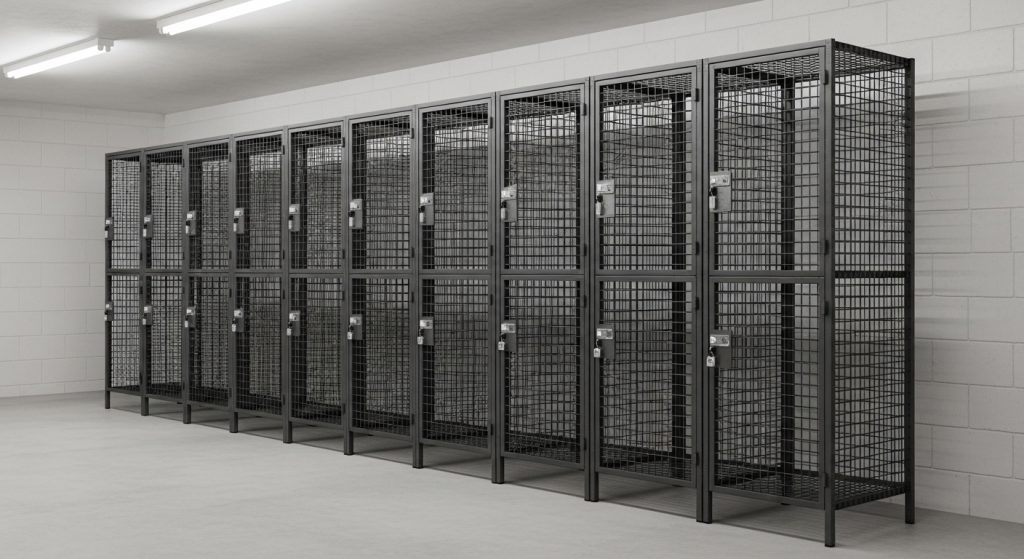
Wire mesh lockers are steel-framed storage units where the panels consist of welded wire, expanded metal, or woven wire mesh — rather than solid sheet steel. That open construction delivers three things solid lockers physically can't: airflow, full content visibility, and fire suppression system compatibility.
The frame is typically built from square steel tube. Mesh panels are either welded directly to the frame or fastened in place for modular assembly. After fabrication, most wire mesh lockers go through a powder coat finishing process, which adds corrosion resistance and a clean, professional appearance in a range of colors.
They work across a surprisingly wide range of environments — apartment storage rooms, military facilities, gyms, schools, bike rooms, and warehouses — anywhere security and visibility need to work together.
Wire Mesh vs. Other Locker Types
| Feature | Wire Mesh Lockers | Solid Steel Lockers | Plastic Lockers |
|---|---|---|---|
| Ventilation | ✅ Excellent | ❌ Poor | ⚠️ Limited |
| Visibility / see-through | ✅ Full | ❌ None | ❌ None |
| Fire suppression compatible | ✅ Yes | ❌ Blocked | ❌ Blocked |
| Corrosion resistance | ✅ Powder coat | ✅ Powder coat | ✅ Inherent |
| Custom sizing | ✅ Yes | ✅ Yes | ❌ Limited |
Types of Wire Mesh Lockers
Not all wire mesh lockers are built the same. The right type depends on your application, your security requirements, and how much floor space you have available.
By Mesh Construction
Welded Wire Mesh Lockers — This is the most common type for commercial and residential use. Steel wires are welded at every intersection, creating a rigid, tamper-resistant grid. They come in different gauges: 6-gauge is heavy-duty for industrial or high-security environments, while 10-gauge is the standard for tenant storage, schools, and gyms. Our wire mesh lockers use a 25×25×T1.2mm steel tube frame with 50×50×T3.0 mesh panels — a construction that balances strength, visibility, and airflow exceptionally well.
Expanded Metal Lockers — Instead of separate wires, expanded metal is cut and stretched from a single steel sheet, creating diamond-shaped openings with no welds at all. This construction is extremely rigid and is commonly specified for military TA-50 gear storage and high-security tool cribs.
Woven Wire Lockers — Woven wire has a lighter, more open appearance and works well in lower-load environments like offices or retail back rooms. However, it is less common in heavy-duty or outdoor applications.
By Tier Configuration
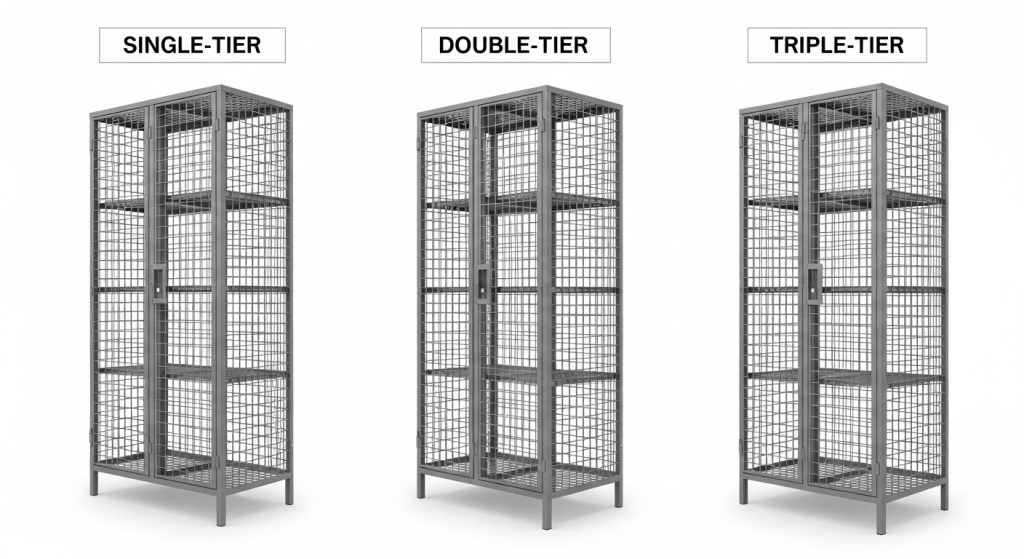
How you configure the height of your lockers directly affects how many units fit in a given space. Therefore, tier selection is one of the most important decisions in any locker project:
- Single-tier wire mesh lockers — Full-height compartments, typically 1800mm to 2400mm tall. Best for bulk storage, bike rooms, large gear, and items too big to split vertically.
- Double-tier wire mesh lockers — The unit height is split into two equal compartments. This doubles your unit count per footprint, making them ideal for apartment tenant storage and offices.
- Triple-tier wire mesh lockers — Three compartments stacked in the same floor space. Perfect for schools, factories, and high-density personal-item storage environments.
Common Wire Mesh Locker Applications
Wire mesh lockers adapt to an impressive range of environments. Here are the most common use cases — and what specs matter most for each.
Apartment & Tenant Storage
Apartment buildings commonly use double-tier wire mesh lockers in basement storage rooms to assign each resident their own secure cage. The open mesh allows property managers to do a quick visual security sweep without unlocking every unit. For these applications, powder coat finish, double-tier configuration, and a simple padlock hasp system are the most common specs. Our mesh locker range includes a dedicated tenant storage locker specifically designed for multi-residential building projects.
Warehouse & Industrial Storage
In warehouses, wire mesh lockers store tools, PPE, and personal items for floor workers. Here, 6-gauge welded wire and a heavy-duty square tube frame are important — the lockers need to handle heavy use, daily impact, and sometimes proximity to forklifts or pallet movers. The open design also lets supervisors confirm PPE is stored and ready at a single glance.
Military & Tactical Gear Storage
Military facilities often specify expanded metal wire mesh lockers for TA-50 gear — individual soldier equipment that must be stored securely and inventoried fast. The open mesh makes visual inventory possible in seconds, rather than opening every solid locker in a row. Padlock hasp compatibility is a standard requirement for this application.
School & Gym Changing Rooms
Schools and fitness centres use wire mesh lockers specifically for ventilation. Wet clothes, gym bags, and sports equipment dry naturally through the open panels, consequently preventing mold and odor buildup. These settings typically use single-tier or double-tier configurations with built-in combination or key lock options.
Bike Storage
Vertical wire mesh bike lockers provide secure, ventilated storage for bicycles in apartment buildings, offices, and transit hubs. Single-tier units with ceiling height options up to 2400mm accommodate most bike sizes comfortably. The open mesh construction also deters theft more visibly than an opaque locker — nothing is hidden from view.
Changing Rooms & Personal Effects
In mines, construction sites, and industrial plants, workers need a locker for personal effects plus a place to sit and change. A personal effect mesh locker with an integrated bench solves both at once. These typically come in single-tier, full-length door configurations. For example, the SFS-MSL-201 wire mesh locker at W610×D610×H1900mm features a three-door layout, solid steel shelf, H100 standing legs, and a hasp for padlock — a proven configuration across industrial changing room projects in multiple countries.
Wire Mesh Locker Sizes & Dimensions
Wire mesh lockers come in a wide range of standard sizes. In addition, most manufacturers — particularly factory-direct suppliers — offer fully custom dimensions for project-specific builds.
| Width | Depth | Height | Common Application |
|---|---|---|---|
| 610mm | 610mm | 1900mm | Standard 3-door wire mesh locker (SFS-MSL-201) |
| 500mm | 500mm | 1700mm | Double-tier mesh locker (SFS-MSL-005) |
| 900mm | 450mm | 1800mm | 9-door storage locker (SFS-SL-021) |
| Custom | Custom | Custom | OEM / project-specific builds |
Standard height options are typically 1800mm (6 ft), 1900mm, 2100mm (7 ft), or 2400mm (8 ft). For double-tier or triple-tier units, the overall locker height stays the same — the interior is simply divided into equal compartments. Custom sizing is available for any dimension. This is especially valuable for architects and contractors specifying lockers to match exact ceiling heights or floor plan layouts.
What to Look for When Buying Wire Mesh Lockers
Choosing a wire mesh locker purely on price or appearance often results in a mismatch between specs and the actual environment. Here's what genuinely matters.
1. Mesh Gauge & Panel Specs
Gauge is the thickness of the wire — a lower gauge number means thicker, stronger wire. For industrial or warehouse environments, specify a wire thickness of T4.0mm or higher. For tenant storage, schools, and gyms, T3.0mm with a 50×50mm mesh square is sufficient and more cost-effective. Smaller mesh squares (25×25mm) add security and are better for high-density or school environments.
2. Frame Material & Finish
Most wire mesh lockers use square steel tube frames. A 25×25×T1.2mm steel tube is the standard structural spec for commercial-grade units. After welding, the locker should receive a powder coat finish — this adds both color and corrosion protection. For damp environments such as outdoor bike storage or pool changing rooms, specify galvanized steel frames and panels instead.
3. Door Style & Configuration
There are three main door styles to consider:
- Single door — One full-width door per compartment; best for individual users
- Double doors — Two doors sharing a compartment; suited for slightly wider units
- Swing door — A larger, wider door for oversized storage compartments
Hinge direction (left or right) also matters significantly in tight corridors. Always confirm this before production.
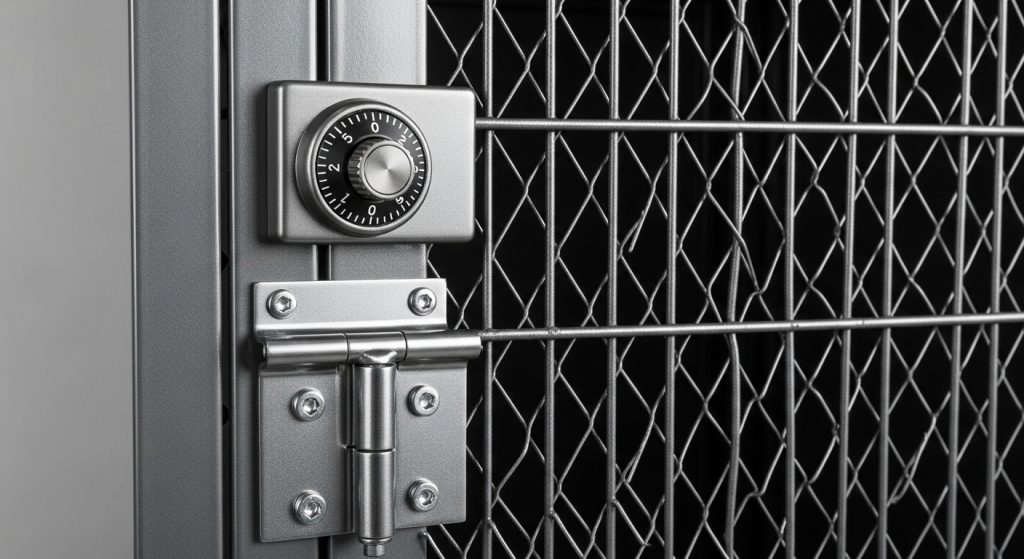
4. Locking Mechanism
Your lock choice affects both convenience and security level:
- Padlock hasp — Most common for industrial and tenant storage. Users bring their own padlock.
- Handle padlock — Integrated handle with a padlock point; cleaner look
- Digital lock — Best for high-turnover environments or managed access control
- Key lock — More convenient for managed facilities where a master key is needed
The SFS-MSL-201 wire mesh locker is compatible with all three lock types — padlock hasp, handle padlock, and digital lock — giving you full flexibility depending on the security requirement of your project.
5. Assembly Format
Fully welded wire mesh lockers are more rigid and secure. Bolt-together (knock-down) panels are easier to ship internationally and install on-site — particularly useful for large-scale projects with flat-pack logistics. Both formats are available, and assemble packing reduces freight costs significantly for bulk or international orders.
6. Customization Options
Good manufacturers can accommodate custom colors, custom dimensions, add-on shelving, nameplates, bench integration, and OEM/ODM branding. For branded environments — a gym chain, a corporate campus, a government facility — color matching and custom sizing make a visible difference to the end result.
For a full look at the configurations available, explore the complete mesh lockers product range — including wardrobe mesh lockers, bulk storage lockers, industrial cage lockers, bike storage, and changing room models.
How to Order Wire Mesh Lockers Direct from a Manufacturer
Ordering directly from a factory — rather than a reseller — gives you better pricing, full customization control, and the ability to supply project scale. Here is a practical checklist:
- Define your space — Floor plan dimensions, ceiling height, and total unit count needed
- Choose your tier — Single, double, or triple based on what you are storing
- Specify frame and mesh — 25×25×T1.2mm frame, 50×50 or 25×25 mesh square, T3.0 or T4.0 wire thickness
- Pick your finish — Powder coat color or galvanized for damp environments
- Confirm your locking mechanism — Padlock hasp, handle padlock, or digital lock
- Decide assembly format — Fully welded or knock-down flat-pack for easier shipping
- Request CAD drawings or 3D simulation — Any serious factory-direct supplier should provide this before production begins
GoodLockers (Steel Furniture Supply) offers 100% custom sizing, OEM/ODM production, and project-scale supply with over 17 years of wire mesh locker manufacturing expertise and export experience across 20+ countries. Browse the SFS-MSL-201 wire mesh locker for full specs, reference projects, and accessory options — or contact the team directly for a free quote.
Frequently Asked Questions About Wire Mesh Lockers
What is the difference between welded wire mesh lockers and expanded metal lockers?
Welded wire mesh lockers use a grid of individual wires welded at each intersection. Expanded metal is cut and stretched from a single steel sheet, forming diamond-shaped openings with no welds at all. Expanded metal is more rigid and is typically specified for military or high-security use. Welded wire is more flexible in design and is the standard choice for commercial and residential applications.
What frame and mesh spec should I look for in a wire mesh locker?
For commercial-grade wire mesh lockers, look for a 25×25×T1.2mm steel tube frame and 50×50×T3.0mm mesh panels. This combination is the industry standard for tenant storage, gyms, and schools. For industrial or high-security environments, upgrade to T4.0mm wire thickness and a 25×25mm mesh square for tighter security.
Are wire mesh lockers compatible with fire suppression systems?
Yes — this is one of the core advantages over solid steel lockers. The open mesh panels allow sprinkler water to pass through freely, making wire mesh lockers compliant with fire suppression requirements in most commercial building codes.
Can wire mesh lockers be used outdoors?
Standard powder-coated wire mesh lockers are not designed for direct outdoor exposure. For outdoor environments, specify galvanized steel frames and mesh panels, which offer much higher corrosion resistance against moisture and UV exposure.
Can I order wire mesh lockers in custom sizes?
Yes. Factory-direct manufacturers like GoodLockers produce wire mesh lockers in fully custom dimensions to match project-specific ceiling heights, floor plan constraints, and architectural specifications. Custom OEM/ODM orders are available for large-scale or branded project requirements.
