
How to Choose a Cell Phone Locker System for Your Facility (2026 Buyer’s Guide)
By Steel Furniture (Good Lockers) Strategy Team
Choosing a cell phone locker system isn't just about buying a metal box; it's about defining a workflow that protects assets without creating a bottleneck in your lobby or changing room. Whether you are a high-security manufacturing plant, a phone-free school, or a government agency, the "box" you choose must match your management reality.
In our 17+ years of manufacturing lockers (since 2007), we have seen facility managers struggle not with the hardware, but with the logistics of key management and charging protocols. This guide covers the exact criteria we use when consulting for major furniture brands and international clients.
Step 1: Define Your "Access Logic" (The Critical First Choice)
The most efficient access logic depends on user turnover. For public venues like gyms or lobbies, use "single-use" modes (users set a temporary code). For assigned staff or students, use "dedicated" modes (fixed keys or RFID badges). Incorrectly matching logic to user type is the #1 cause of operational failure.
Most buyers look at materials first, but you should look at workflow first. Before you browse a catalog, ask: Who holds the master key?
- Public/Transient Use (Gyms, Courthouses, Lobbies): Users change daily. You need a system where the user brings their own credential (a PIN code they invent on the spot) or a self-service kiosk.
- Assigned/Private Use (Factories, Offices, Schools): The same person uses the same compartment every day. Here, a mechanical key or a fixed RFID badge linked to their employee ID is superior.
The "Lost Key" Reality
In our experience exporting to the USA and Singapore, we found that facilities using traditional cam locks (keys) spend approximately 15-20% more annually on management time than those using digital systems.
| Feature | Mechanical Key | Digital Keypad | RFID/Smart Lock |
| Upfront Cost | Low | Medium | High |
| Mgmt. Effort | High (Key distribution/replacement) | Low (Master code override) | Lowest (Remote disable) |
| Best Application | Assigned Staff (Low Turnover) | Public/Guest (High Turnover) | Corporate/Secure Zones |
Pro Tip: If you choose mechanical keys, ensure you have a "Master Key" system in place. We strictly advise against standard locks without manager override capabilities for facilities with more than 50 users.
Step 2: Selecting the Right Lock Mechanism
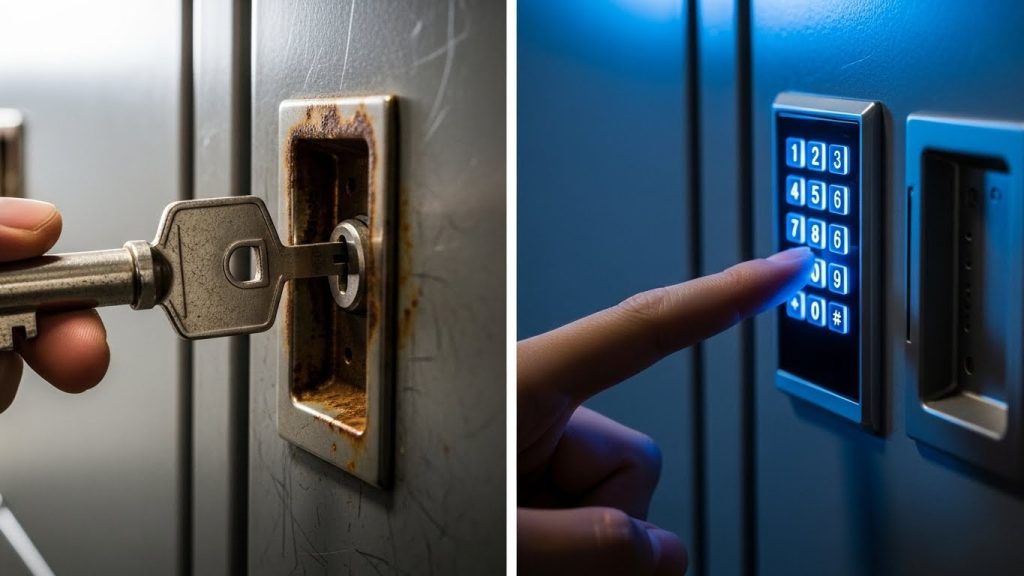
Digital keypad locks are the industry standard for cell phone lockers in 2026 due to their "audit trail" capabilities and lack of physical keys. However, for budget-conscious projects with stable user groups, mechanical hasp locks (user-supplied padlock) offer the lowest maintenance liability.
We offer three primary locking categories, each tested in our Huizhou facility for distinct environments:
- Digital Keypads: These are our top recommendation for "Phone-Free Schools." If a student forgets their code, a teacher can use a Master Code or Management Key to open it instantly. No bolt cutters required.
- RFID Systems: Ideal for factories where employees already wear access badges. We can often integrate the locker lock with your existing 13.56MHz building access cards.
- Mechanical Key Locks: The budget option. We use 1.0mm galvanized steel housing to ensure the lock cylinder doesn't spin, but be warned: keys will get lost.
Step 3: Material & Durability (The "Student-Proof" Test)
The gold standard for cell phone locker durability is 16-gauge (1.5mm) to 20-gauge (1.0mm) galvanized steel with a powder-coated finish. For high-humidity areas like pools or spas, High-Density Polyethylene (HDPE) or Phenolic material is mandatory to prevent rust and delamination.
At Good Lockers, we moved our metal factory in 2024 to accommodate advanced powder coating lines because we saw too many competitors' lockers rusting after two years.
- Steel (Our Standard): We use galvanized steel (1.0mm thickness) for our cell phone lockers. This is significantly more rigid than the 0.7mm "economy" steel found on generic marketplaces. In our impact testing, 1.0mm steel resists "prying" attempts with pocket knives, whereas thinner steel warps.
- Powder Coating: It’s not just for color. A high-quality powder coat seals the steel against finger oils and moisture, which is critical for lockers touched hundreds of times a day.
Authenticity Note: We recently customized a batch of "Phone Storage Lockers with Stand" (30/50 doors) where we used a disassemble package design. This allowed the client to save 40% on freight costs while still getting a rigid, heavy-duty steel unit—something fully welded units can't offer.
Step 4: Charging Capabilities: Hardwired vs. Plug-in
If you select charging lockers, ensure they utilize USB-C Power Delivery (PD) standards rather than standard AC outlets to reduce heat buildup. You must verify that the locker unit has built-in ventilation louvers to dissipate the heat generated by lithium-ion batteries during rapid charging.
Charging is the most requested feature, but also the most complex.
- Ventilation is Non-Negotiable: As we note in our mesh locker designs, air circulation is vital. For charging lockers, we engineer rear or side ventilation slots. Without this, a phone charging at 20W+ inside a sealed steel box can overheat, triggering battery safety shutoffs.
- Cable Management: We recommend lockers with a dedicated "false back" or channel where the facility manager manages the power bricks, leaving only the USB cable tip accessible to the user. This prevents theft of the charging adapters.
Step 5: Size & Fit (The "OtterBox" Factor)
A standard cell phone locker compartment should measure at least 4 inches (100mm) high by 8 inches (200mm) deep. This depth is required to accommodate "Max" or "Ultra" sized smartphones inside bulky protective cases like OtterBoxes without bending the charging cable connectors.
Don't just measure the phone; measure the phone plus the connector.
- Our Configs: We typically manufacture 30-door or 50-door configurations.
- The Depth Check: Through our OEM work, we found that shallow lockers (6 inches deep) cause charging cables to fray because the door presses against the plug. We recommend 200mm (approx. 8 inches) depth to ensure longevity of your charging cables.
Step 6: Installation & ADA Compliance
To meet ADA (Americans with Disabilities Act) standards, at least one locker compartment and its mechanism must be placed between 15 inches and 48 inches above the finished floor. Wall-mounted units must be installed at a specific height to ensure the top row remains accessible.
- Wall-Mounted: Saves floor space but requires professional anchoring to studs or masonry.
- Free-Standing with Stand: We offer a specialized locker stand (fixed to the ground by screws) for our 30/50 door units. This is often preferred in lobbies where wall space is taken by windows or art.
- Reach Ranges: When we design custom layouts, we ensure the interactive touchpoints (keypads) fall within the 15"-48" zone for accessible units.
Quick Comparison Summary
| Locker Type | Best For | Security Level | Mgmt. Effort | Price |
| Wall-Mounted (Key) | Small Offices | Medium | High | $ |
| Free-Standing (Digital) | Schools/Gyms | High | Low | $$ |
| Charging Locker (RFID) | Airports/Hospitals | High | Low | $$$ |
Conclusion
The "best" system is one that your staff doesn't have to manage constantly. If you are a school, the Phone Locker Buying Checklist usually points to non-charging, digital-access units to minimize classroom disruptions. If you are a high-end spa, a charging unit with RFID integration adds value to the guest experience.
Ready to configure your system?
As a manufacturer with no MOQ (Minimum Order Quantity), we can help you prototype a single unit or outfit an entire campus. Contact Steel Furniture (Good Lockers) today for a custom drawing and quote.
Frequently Asked Questions (FAQ)
What is the standard size of a cell phone locker compartment?
The standard size is typically 7-8 inches wide, 4-5 inches high, and 8-10 inches deep. This accommodates almost all modern smartphones, including those with large protective cases. At Good Lockers, our standard 30-door units use these dimensions to ensure compatibility with "Pro Max" and "Ultra" device sizes.
Can cell phone lockers be used outdoors?
Standard steel lockers cannot be used outdoors as they will rust. For outdoor use, you must choose 304 stainless steel or Phenolic (HPL) lockers, which are water-resistant and UV-stable. We manufacture specific outdoor solutions using compact laminate that withstands humidity and rain.
How do emergency overrides work on digital lockers?
Digital lockers come with a Master Code or a physical Master Override Key. If a user forgets their PIN or leaves their phone locked overnight, the facility manager can use the Master Code to open the door instantly. This feature is standard on all our digital electronic locks.
Do cell phone lockers require electricity?
Standard storage lockers do not require electricity. However, charging lockers require a standard 110V/220V outlet to power the internal USB hubs. Additionally, some smart RFID lockers may require hardwired power or batteries (usually AA) for the locking mechanisms.
Are cell phone lockers safe for schools?
Yes, they are highly effective for schools. We recommend heavy-duty steel (1.0mm) to resist vandalism and centralized location installation (like the main office or classroom entry) to monitor usage. For schools, we often supply units with "Master Keys" so administrators maintain full control.
